Creating a shade structure (plant pergola)
Putting up a structure and dressing it with climbers to create a living shady corner, choosing the plant according to what you want: quick coolness, hanging fruit, or decoration.
Introduction
A shade structure (or plant pergola) is a light framework dressed with climbing plants that form a living roof. Unlike a tarp or a canvas, this roof of leaves filters the sun while letting the air circulate: you gain coolness without the stifling effect. The right bioclimatic reflex, especially on the south side, is to choose a deciduous climber: it shades in summer then, once its leaves have fallen, lets light and warmth back in winter.
Background
The shade structure renders several services at once, shade for a terrace or for crops that suffer from heat, a refuge for pollinators if the climber flowers, and sometimes a harvest (grapes, kiwi, squash). It is a concrete application of the permaculture principle 'each element performs several functions'.
Who this guide is for
Gardeners who want a cool corner in summer, to shade a full-south terrace or to train a food-producing climber.
Why it matters
Free, evolving shade, a cooler microclimate, a support for growing upward (space saving) and, depending on the chosen plant, nectar-rich flowers or fruit.
Detailed steps
- Step 1
1. Choose the location and orientation
An east or west aspect gives pleasant shade at the hot hours; full south is more strongly sunlit and will need a denser plant cover. Think about what the structure overhangs (table, path, crop) and about circulation: a shade structure is lived in underneath.
- Step 2
2. A structure sized to the plant's weight
This is the point not to miss: the support must hold the ADULT plant, not the small starter. A light plant (annual squash, hop whose stems die back each winter) makes do with a simple structure; a heavy woody climber (vine, kiwi and especially wisteria) demands thick posts of wood or metal, thin trellises and mesh end up twisted or torn off. Wood (warm, to be maintained), steel (very strong), aluminium (light and durable): choose according to the intended plant.
- Step 3
3. Put up the supports to climb on
Twining climbers (hop, wisteria, kiwi, honeysuckle) wind around a support: stretch stainless-steel cables with tensioners, or fix a trellis to the posts. The vine and squashes cling by tendrils. Guide the young stems by hand the first few weeks and tie them loosely, with soft ties, so as not to injure them.
- Step 4
4. Choose the climber according to your goal
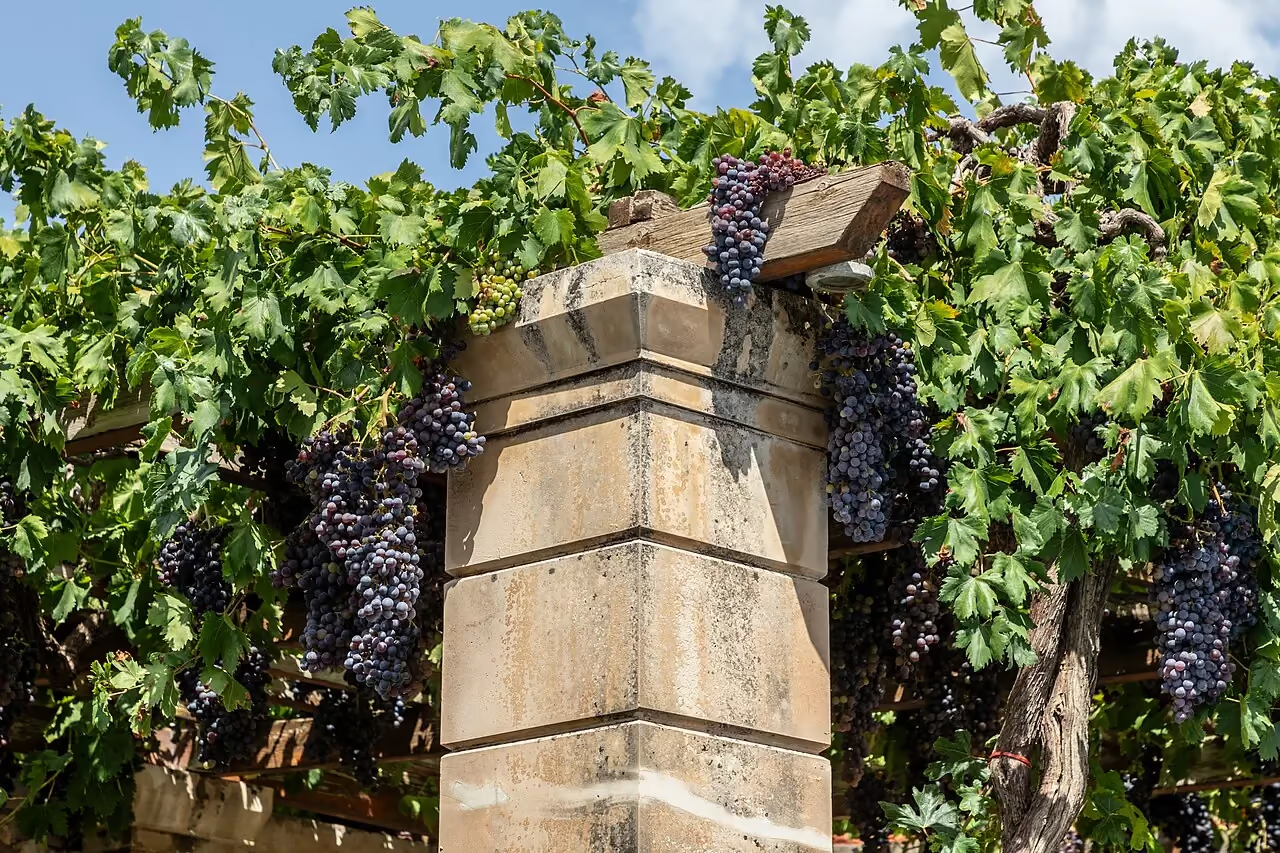
FOR QUICK, DENSE SHADE: the golden hop (Humulus lupulus 'Aureus'), a deciduous perennial with very fast spring growth (about 5 to 6 m for the golden cultivar, the wild species climbing higher), with luminous golden foliage; it prefers gentle sun to part shade, burning full sun damages its leaves, and can sucker, so keep it contained. FOR FRUIT HANGING OVERHEAD: the grapevine (Vitis vinifera), the arbour climber par excellence, full sun on the south side to ripen its bunches, pruned in frost-free winter. OTHER OPTIONS: kiwi and hardy kiwi (Actinidia), vigorous and productive, but which generally need a male and a female plant (except self-fertile varieties) and a sturdy support; climbing squashes and gourds, spectacular annuals with hanging fruit, for a summer shade to redo each year; honeysuckle (Lonicera) for its scent. TO HANDLE WITH CARE: wisteria (Wisteria), superb and nectar-rich but extremely vigorous and heavy (very robust supports required), and whose seeds are toxic if ingested (source: toxiplante.fr), to keep in mind with young children.
Concrete examples
- A full-south terrace: a vine trained on a metal pergola, shade in summer, bunches in autumn, light regained in winter.
- Small budget, quick effect: climbing squashes or a golden hop on a wooden structure, shade within the first summer.
Common mistakes to avoid
- Undersizing the structure: an adult wisteria, vine or kiwi is heavy and warps a support that is too light.
- Putting an evergreen climber full south: you lose the sun and warmth in winter. On the south side, prefer a deciduous one.
- Forgetting that some climbers bear toxic parts (wisteria seeds, honeysuckle berries, the green fruit of passionflower): worth knowing with children and animals.
- Relying on squash or hop for permanent shade: squash dies with the frosts, hop regrows from its crown in spring, but there is no shade in winter.
Tips & best practices
- On the south side, a deciduous climber = cool in summer, bright in winter: the best of both worlds.
- For a harvest, orient the vine or kiwi to the sun; for foliage only, the hop tolerates part shade.
- Plant at the foot of the structure, in good soil, and water well the first year while it establishes.
Frequently asked questions
- Which climber grows fastest for shade?
- For shade from the very first season, climbing squashes (annuals) and the golden hop (a perennial with annual stems) are unbeatable for speed. For lasting shade that also gives a harvest, the vine settles in over a few years.
- Does passionflower give edible fruit on a pergola?
- The blue passionflower (Passiflora caerulea) is mainly ornamental: its fruit is only edible at full ripeness and stays bland, and the green fruit as well as the leaves contain cyanogenic glycosides, compounds well documented in the genus Passiflora, more concentrated in the green parts and the unripe fruit. Grow it for its flowers, not for the harvest; at the slightest doubt, do not eat it.
Key takeaways
- Leaves rather than a tarp: shade that breathes.
- South side: a deciduous climber (shade in summer, sun in winter).
- A structure set to the weight of the ADULT plant, not the young one.
- Quick shade: golden hop, squashes. Hanging fruit: vine, kiwi.
- Wisteria, honeysuckle and passionflower have toxic parts: take care with children and animals.
Sources
- RHS (Royal Horticultural Society) : How to grow wisteria (rhs.org.uk/plants/wisteria/growing-guide)
- Kim et al. (2017). Acute intoxication due to Wisteria floribunda seed in seven young children. Pediatrics International, 59(5), 600-603.
- Rondeau (1993). Wisteria toxicity. Journal of Toxicology: Clinical Toxicology, 31(1), 107-112.
- Seigler, D.S., Spencer, K.C., Statler, W.S., Conn, E.E. & Dunn, J.E. (1982). Tetraphyllin B and epitetraphyllin B sulphates: novel cyanogenic glucosides from Passiflora caerulea and P. alato-caerulea. Phytochemistry, 21(9).
- Wendt, S. et al. (2023). Expositionen mit Fruchtpflanzen in Deutschland im Zeitraum 2010–2019. Bundesgesundheitsblatt, 66(12), 1423-1433.