In the pathway: Advanced regenerative approaches
Agroforestry
The association of trees, shrubs, crops and sometimes livestock within a single system.
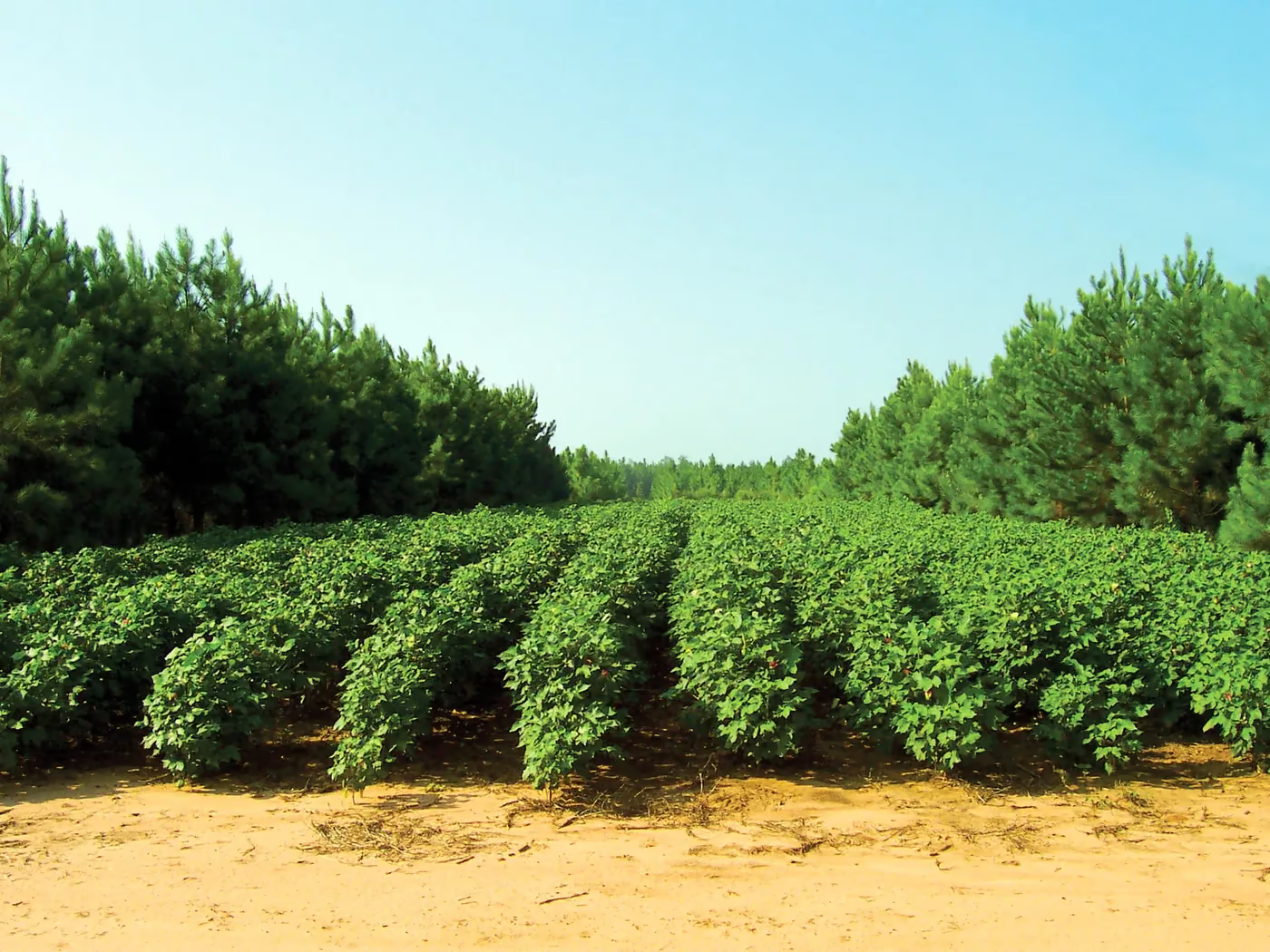
Agroforestry combines trees and crops on the same plot, here cotton grown in alleys between rows of pines.
Explanation
Agroforestry combines agricultural and tree production to improve soils, create ecological corridors, produce biomass and provide shade and resilience. It exists as alleys, parklands, silvopasture or forest gardens. A traditional practice (hedgerows, orchard-meadows, the Spanish dehesa) rediscovered and formalised by INRAE and the AFAF (French Agroforestry Association) since the 1990s.
Refined definition
Agroforestry groups together all agricultural systems that integrate trees with crops or livestock on the same plot, simultaneously or in succession. It differs from silviculture (trees alone) and from classic agriculture (crops alone). The services rendered by trees: functional shade, nitrogen fixation (woody legumes), recovery of part of the nitrogen leached below crop roots (the safety-net role of tree roots, Allen et al., 2004), windbreak, carbon capture, refuge for beneficial insects.
Key points
The main forms
INTER-PLOT ALLEYS: rows of trees spaced 20-40 m apart in cereal fields, typical of the INRAE Restinclières farm (Hérault). ORCHARD-MEADOWS: fruit trees in grazed grassland, a European tradition. SILVOPASTURE: livestock under tree cover, the Spanish dehesa (holm oaks + pigs), Breton hedgerows. FOREST GARDEN: the densest, multi-layer version, for the family vegetable garden, see the Layer concept.
Documented benefits
One hectare combining trees and cereals can produce as much as about 1.3 hectares with the same cereals and the same trees grown separately: this is the 13-year measurement of a poplar and durum wheat system (Dupraz et al.), cited by INRA in 2013. Cereal output falls, by half over the cycle in that measurement: the gain comes from the extra wood. Reduced erosion; carbon storage is real but highly variable with tree density and age. Sources: Metay A., Butault J.-P., Bamière L., in Pellerin S. et al., Quelle contribution de l'agriculture française à la réduction des émissions de gaz à effet de serre ?, INRA, 2013; Dupraz C., Liagre F., Agroforesterie : des arbres et des cultures, France Agricole, 2008.
Watch out for
- • A long-term commitment: trees take many years to yield their timber or fruit, a timescale to plan for, especially on rented land.
- • Choose species suited to the climate AND the use (timber, fruit, biomass), the common walnut is exemplary in cereal agroforestry.
Sources
- Allen, S.C. et al. (2004). Safety-net role of tree roots: evidence from a pecan (Carya illinoensis K. Koch)-cotton (Gossypium hirsutum L.) alley cropping system in the southern United States. Forest Ecology and Management, 192(2-3), 395-407.
- Dupraz, C. & Liagre, F. (2008). Agroforesterie : des arbres et des cultures. Paris : France Agricole.
- Pellerin, S. et al. (2013). Quelle contribution de l'agriculture française à la réduction des émissions de gaz à effet de serre ? Potentiel d'atténuation et coût de dix actions techniques. Paris : INRA.