Rhizobium
Symbiotic bacteria of legumes that fix nitrogen from the air.
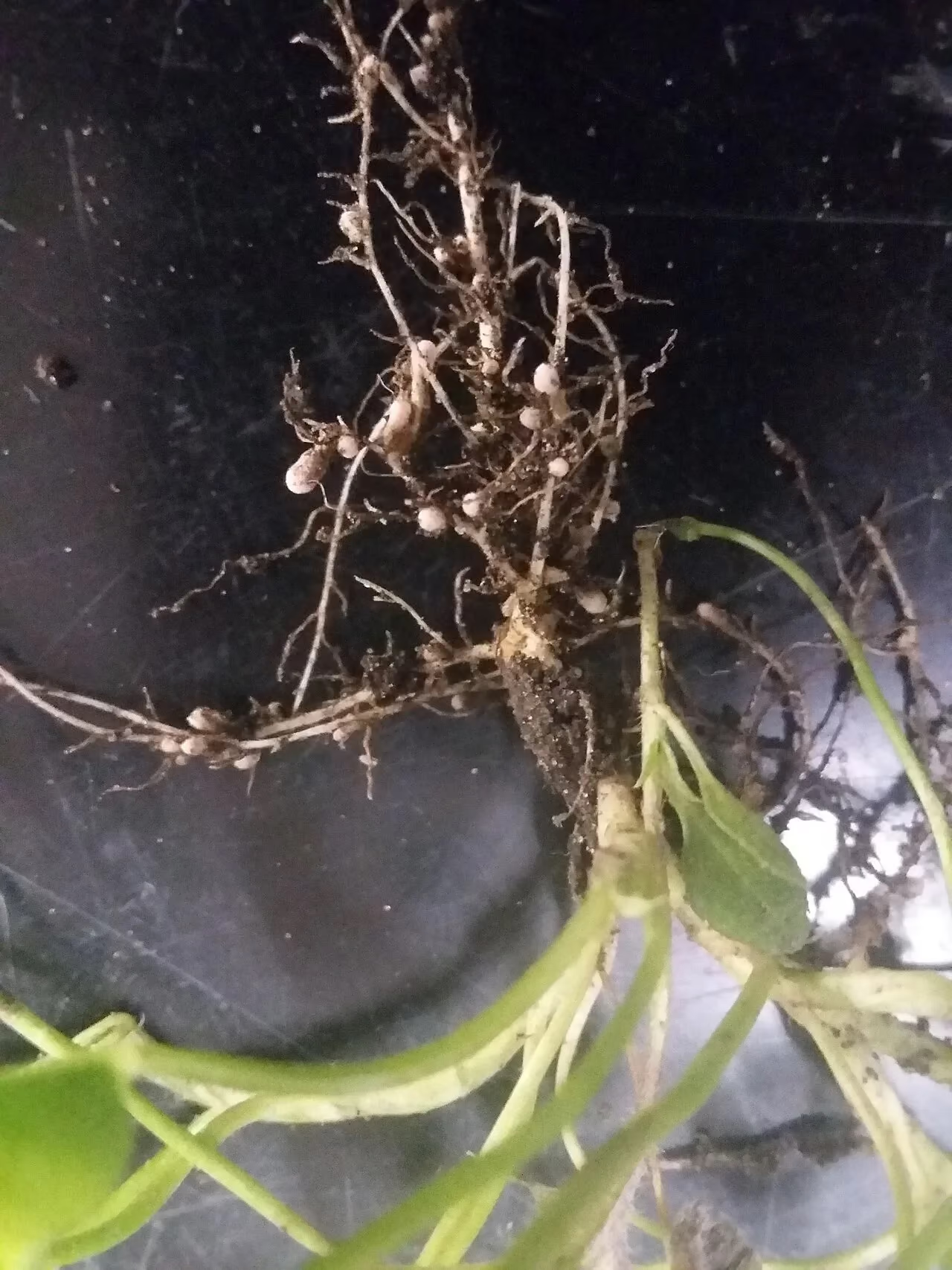
The nodules on the roots of clover (and of other legumes) house Rhizobium bacteria, which capture nitrogen from the air and make it available to the plant.
Photo: Bwiltz · CC BY-SA 4.0 · source
Explanation
Present in nodules on the roots of legumes (bean, pea, clover, lupin, alfalfa, broad bean), these bacteria of the genus Rhizobium (and relatives: Bradyrhizobium, Sinorhizobium, Mesorhizobium) transform the N₂ nitrogen of the air into ammonia NH₃ and then into forms the plant can use. A symbiosis discovered by Hellriegel and Wilfarth in 1888, which revolutionised agronomy by explaining the age-old rotation with legumes.
Refined definition
The term Rhizobium strictly refers to a bacterial genus, but in practice it is used for all rhizobia (Bradyrhizobium for soybean, Sinorhizobium for alfalfa, etc.). Each legume has its preferred bacterial partner: clover ↔ R. leguminosarum biovar trifolii; bean ↔ R. etli; soybean ↔ Bradyrhizobium japonicum. The symbiosis forms in nodules visible when uprooting: a healthy nodule is pink to red (the colour of leghemoglobin, the plant equivalent of our haemoglobin).
Key points
Quantifying the fixation
The amount of nitrogen fixed varies widely with species, growth and soil: it goes hand in hand with the nitrogen built up in the legume's above-ground parts (Anglade et al., 2015). When the seeds are harvested (bean, pea), most of that nitrogen leaves with the crop; roots and residues leave only a small part of it for the next crop (Flynn and Idowu, 2015). Used whole as a green manure (mown, then left on the soil or worked into the surface), the legume enriches the soil more, but the following crop takes up only part of it in the first year, and a good share stays in the soil (Seo et al., 2006). Sources: Flynn and Idowu (2015), Nitrogen Fixation by Legumes, New Mexico State University, Guide A-129; Anglade et al. (2015), Ecosphere; Seo et al. (2006), Agronomy Journal.
Preserving the symbiosis: what to do, what not to do
TO DO: leave roots and haulm in place after harvest. TO AVOID: excess nitrogen in the soil (the plant no longer needs the symbiosis and “lays off” its bacteria); very acid soils (pH < 5.5). On the other hand, growing Alliaceae nearby, which tradition advises against, has no effect on nodulation demonstrated in the field.
Inoculation
For pea and broad bean, the rhizobia are already in the soil: there is no need to inoculate the seed (Terres Inovia). On the other hand, for a legume whose bacterium is missing from the soil, such as soybean (its rhizobium is absent from Western European soils) or lupin (its Bradyrhizobium is not present in every French soil) (Terres Inovia), or on new soil (creating urban gardens), inoculation with specific Rhizobium may help, but its effect is inconsistent: in field trials on common bean, adding rhizobia changed only a few traits, and not in the same way from year to year (Reinprecht et al., 2020); in a trial on hairy vetch and red clover, inoculation changed neither nodulation nor fixation, likely because of the strains already present in the soil (Perrone et al., 2020). Inoculants are available in organic garden centres.
Watch out for
- • If a bean or pea forms no pink nodules when uprooted: soil too acid (lime moderately), excess nitrogen (reduce inputs), or bacteria absent (inoculation may help, with inconsistent results).
- • Legumes and Alliaceae: companion-planting tradition keeps them apart, but no effect on nodulation has been demonstrated in the field, and trials even grow broad bean with garlic (Hamoda et al., 2026).
- • Do not confuse healthy nodules (pink, smooth, on the roots) with parasitic nematode galls (Meloidogyne), which are yellowish, deforming and on the main root.
Examples
- • Bean (Phaseolus vulgaris) ↔ Rhizobium etli
- • Pea (Pisum sativum) ↔ R. leguminosarum bv. viciae
- • White clover (Trifolium repens) ↔ R. leguminosarum bv. trifolii
- • Soybean (Glycine max) ↔ Bradyrhizobium japonicum
- • Alfalfa (Medicago sativa) ↔ Sinorhizobium meliloti
Sources
- Flynn, R. & Idowu, J. (2015). Nitrogen Fixation by Legumes. Guide A-129. Las Cruces : New Mexico State University.
- Anglade, J., Billen, G. & Garnier, J. (2015). Relationships for estimating N2 fixation in legumes: incidence for N balance of legume-based cropping systems in Europe. Ecosphere, 6(3), 1-24.
- Seo, J.-H., Meisinger, J.J. & Lee, H.-J. (2006). Recovery of nitrogen-15-labeled hairy vetch and fertilizer applied to corn. Agronomy Journal, 98(2), 245-254.
- Reinprecht, Y. et al. (2020). Effects of nitrogen application on nitrogen fixation in common bean production. Frontiers in Plant Science, 11, 1172.
- Perrone, S. et al. (2020). Nitrogen fixation and productivity of winter annual legume cover crops in Upper Midwest organic cropping systems. Nutrient Cycling in Agroecosystems, 117(1), 61-76.
- Hamoda et al. (2026). Effect of faba bean-garlic intercropping on low-molecular-weight organic acids, yield components, and profitability under different spatial arrangements. Scientific Reports, 16.