Germination, step by step
Understanding what a seed needs to wake up, water, air, warmth, and the steps to succeed with your sowings, break dormancy and test your old seeds.
Introduction
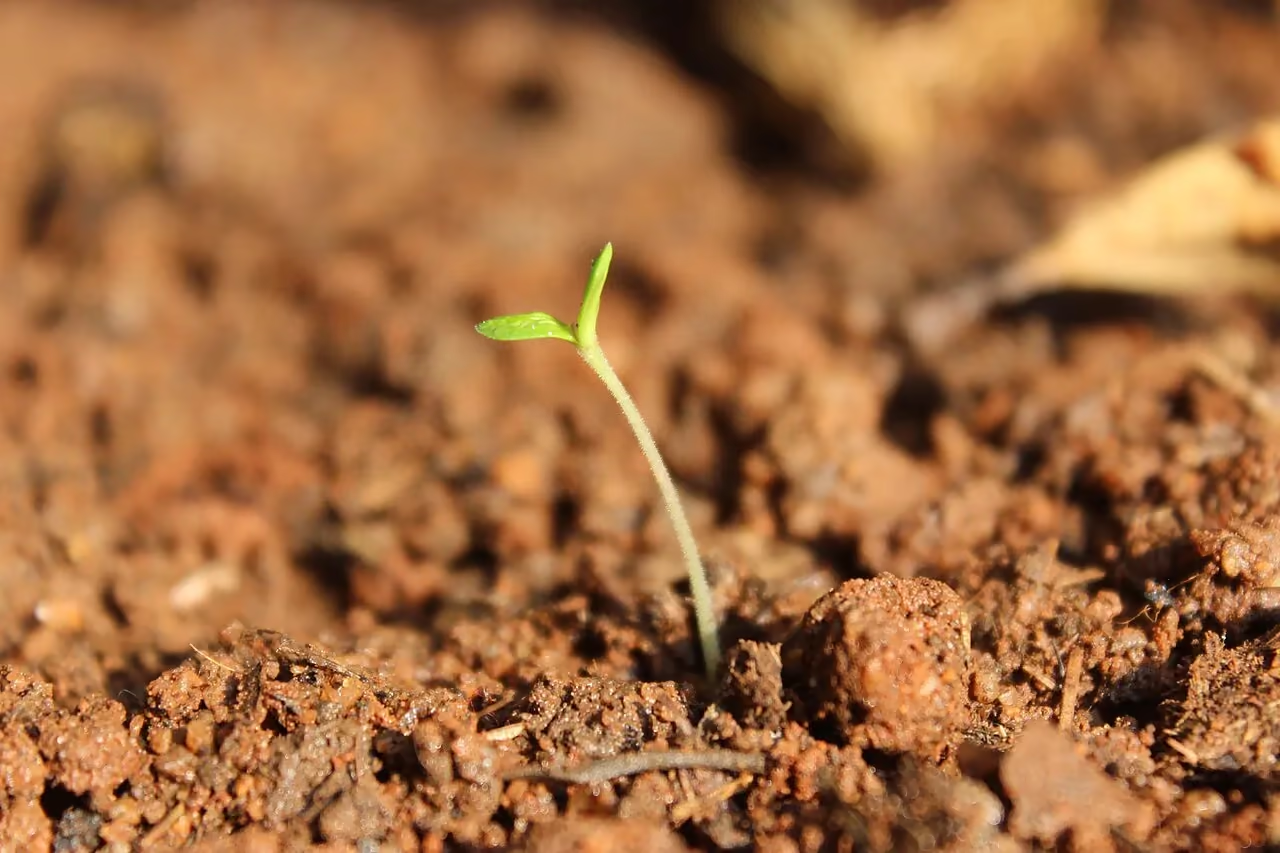
For a seed, germinating means coming out of its slowed life and launching a seedling. The Académie d'Agriculture de France distinguishes three times: imbibition (the seed drinks and swells), germination proper (the radicle pierces), then the growth of the seedling. Three conditions are essential, water, oxygen and temperature, and, for some species only, light also plays a role.
Background
A dry seed can keep for months, even years: it is its dehydration that keeps it dormant. As soon as it regains water, its enzymes wake up, digest its reserves and feed the embryo. Understanding this mechanism means understanding most sowing failures, almost always a matter of water, air, warmth or dormancy.
Who this guide is for
Anyone who sows, from the first tray of tomatoes to tree seeds gathered on a walk.
Why it matters
A successful sowing is self-reliance (your own plants, your own seeds) and great savings. And knowing how to break dormancy or test an old packet avoids many sowings that never come up.
Detailed steps
- Step 1
1. The three conditions: water, oxygen, warmth
Water rehydrates the seed and wakes its enzymes (Académie d'Agriculture). Oxygen lets it breathe to produce the energy of germination (UNISCIEL plant-biology course), which is why a waterlogged potting soil, which drives out the air, is the number-one enemy of sowings. Temperature, finally, controls the speed: each species has a minimum threshold, an optimum and a maximum, linked to its climatic origin (Académie d'Agriculture).
- Step 2
2. Light: it depends on the seeds
Contrary to a common idea, not all seeds need light to germinate. Some are indifferent to it (the bean), others are stimulated by light and are therefore sown on the surface or barely covered (lettuce, celery, basil), and others germinate better in the dark and want to be covered (spinach, lamb's lettuce, beetroot, chard). This behaviour, driven by a pigment called phytochrome, is documented by the Académie d'Agriculture.
- Step 3
3. Breaking dormancy: stratification, scarification, soaking
Many wild, tree and shrub seeds are 'dormant': a mechanism that stops them germinating at the wrong time (Académie d'Agriculture). The FAO distinguishes dormancy linked to the seed coat (the hard shell) and that linked to the embryo. Three actions break them. Cold STRATIFICATION simulates winter: mix the seeds with a damp substrate (sand, peat) in a box in the fridge, a few weeks to a few months at around 2 to 5 °C (the FAO gives an order of magnitude of 20 to 60 days depending on species), essential for rose-family fruit trees (apple, pear, cherry) and many perennials. SCARIFICATION weakens hard coats: a small nick with a knife (away from the germ) or a rub with sandpaper, for some legumes and hard-seeded ornamentals. SOAKING (24 to 48 h in lukewarm water) softens large thick-skinned seeds (pea, nasturtium, beetroot). Tip: if a seed soaked overnight does not swell, it needs to be scarified.
- Step 4
4. The right temperature, the right time
There are two broad families (the Ferme de Sainte-Marthe seed company). The COLD-SENSITIVE ones of warm origin, tomato, aubergine, pepper, melon, cucumber, courgette, need soil already well warmed and are often started indoors or under cover. The HARDY ones, spinach, radish, lettuce, carrot, broad bean, germinate from a few degrees and are sown early in place. The exact figures vary from one source to another: better to remember benchmarks (the cold-sensitive above roughly 15 to 20 °C, the hardy well below) than a single number. The golden rule of patience: a seed sown in warm soil comes up faster and more surely than a seed left for weeks in cold, damp soil.
- Step 5
5. Sowing depth and pricking out
The classic horticultural rule: bury a seed at about two to three times its diameter. The tiniest seeds therefore stay on the surface or are barely veiled with potting soil, the large ones (squash, beans) tolerate being deeper. Sow a little deeper in light, sandy soil, less in heavy soil. Prick out the plants when they have formed their first true leaves (beyond the two cotyledons), and put them in the open ground only once the last frosts are past.
- Step 6
6. Test your seeds before sowing
To check an old packet, the damp-paper test: place a round number of seeds (10 or 20) on a damp paper towel in a closed box, keep it damp without soaking, at around 20 °C (rather 25 °C for pepper and aubergine), and check every three days for two to three weeks. The germination rate = seeds up ÷ seeds placed: 7 out of 10 is 70 %. Above 80 % the batch is excellent; around 50 %, sow denser to compensate; very low, renew your seeds. The species that like the dark (spinach, lamb's lettuce, beetroot) are better tested covered with a little potting soil.
Common mistakes to avoid
- Overwatering: a waterlogged potting soil deprives the seed of oxygen and encourages 'damping off', a rotting of the young plants at the collar due to soil fungi (Pythium, Rhizoctonia, Fusarium). There is no reliable cure: avoid it with a light potting soil, good drainage and aeration (Bayer Vegetables, Jardiner Malin factsheets).
- Sowing too deep: the seed lacks air, and the small light-needing seeds do not come up.
- Sowing too early in cold soil: emergence drags and the seeds rot. A slight delay is better than a failed early sowing.
- Lacking light after emergence: the seedlings become leggy (drawn-out, pale stems), common in indoor sowings near a poorly lit window.
- Forgetting dormancy: sowing as-is tree or perennial seeds that require a cold spell, then thinking them 'dead'.
Tips & best practices
- Sow in a special fine, light seed-sowing mix, rather than in a rich potting soil that holds too much water.
- Label straight away: species + date. You always forget.
- Save your own seeds from stable (non-hybrid) varieties to close the loop.
- When in doubt about a wild seed, look up its dormancy type before sowing, many need the cold of winter.
Frequently asked questions
- My seeds aren't coming up: dead or dormant?
- Do the damp-paper test on a few seeds. If nothing moves in three weeks at the right temperature, either the batch is no longer viable, or it is a dormant species (trees, wild perennials) that needs a cold spell or scarification.
- Do I need to soak all seeds before sowing?
- No. Soaking only helps large hard-skinned seeds (pea, nasturtium, beetroot). For small seeds, it is useless and makes them hard to handle.
Key takeaways
- Water, oxygen and warmth first; excess water kills more sowings than a lack of it.
- Light concerns only some seeds: fine ones on the surface, large ones buried.
- Tree and wild-perennial seeds: think dormancy (cold, scarification, soaking).
- Warm soil = fast emergence: better to sow a little late than too early.
- A damp-paper test avoids sowing a whole row of dead seeds.
Sources
- Académie d'Agriculture de France, Encyclopédie : fiches 06.04.Q01 « Qu'est-ce que le processus de germination ? » et 06.04.Q02 « Les facteurs de la germination »
- INRAE, Ephytia (Tropilég) : Fontes de semis