Multi-species hedge
Windbreak, wildlife shelter, food: the hedge is an ecosystem in itself.
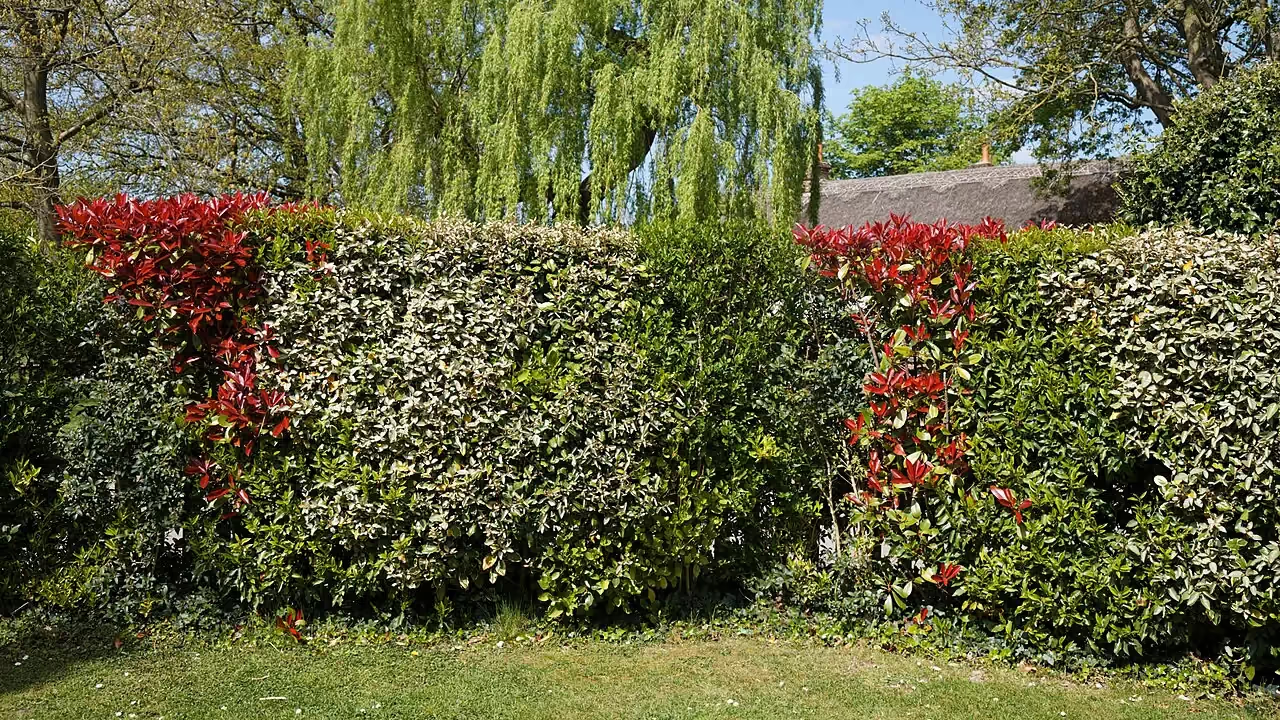
Introduction
A multi-species hedge (or country hedge) brings together a dozen different local species to provide a windbreak, wildlife refuge, nectar-rich flowers, fruit and firewood. It is one of the most rewarding and durable structures you can set up.
Background
Field hedges have declined by about 70 % in France since 1950 (Ministry of Agriculture, drawing on the CGAAER report “La haie, levier de la planification écologique”, no. 22114, April 2023). The destruction continues: about 23,500 km of hedges lost per year over 2017-2021. Replanting them, even on a small scale, restores ecological corridors crucial for pollinators, birds and bats.
Who this guide is for
Owners of at least 10 linear metres (property boundary, meadow edge, shelter for a vegetable garden). Advised on any open, wind-exposed ground.
Why it matters
Downwind, a hedge slows the wind most over about ten times its height; the effect then fades and remains measurable up to about 30 times its height (Brandle et al., University of Nebraska). Shelters a rich fauna, birds, beneficials, small mammals. Can improve the yield of sheltered crops. Stores carbon in the wood and the soil.
What to understand before starting
Detailed steps
- Step 1
Choose local species
Favour 8 to 12 native species: blackthorn, hawthorn, black elder, dogwood, hazel, hornbeam, field maple, guelder rose, spindle, common privet.
- Step 2
Design the composition
Alternate shrubs (1.5-3 m) and small trees (5-8 m). Include at least 1 nitrogen fixer (eleagnus, alder) and 1 early-flowering species (blackthorn, cornelian cherry).
- Step 3
Set out the line
A straight or wavy line. Space the plants 60 to 80 cm apart on 1 or 2 rows (staggered if 2 rows, 50 cm spacing).
- Step 4
Plant bare-rooted
Dip the roots in a slurry (soil + cow dung + water). Trim the roots and branches. Plant at the collar level, firm, water copiously.
- Step 6
Maintain for 3 years
Water in case of drought the first 2 summers. Weed around the plants the 1st year. Prune to shape in winters 2 and 3 (coppice if needed).
Concrete examples
- Windbreak hedge (50 m): blackthorn + hawthorn + dogwood alternating, eleagnus every 5 m.
- Edible hedge: hazel + elder + cornelian cherry + serviceberry + blackcurrant as filler.
- Small hedge (10 m): 6 plants alternating hawthorn, elder, hazel, dogwood.
Common mistakes to avoid
- Planting cherry laurel or thuja: ecological dead ends, allergenic, of little value to wildlife.
- Trimming every year with shears: impoverishes the hedge and prevents fruiting.
- Forgetting to water the first two summers: many young plants die.
- Planting too tightly (< 50 cm): strong root competition, dieback.
Tips & best practices
- Order from a local nursery or through 'Plantons des haies' programmes.
- Ask for 60-90 cm bare-rooted forest plants: better establishment and much cheaper than potted plants.
- Leave nest boxes and wood piles at the base: it multiplies the ecological value.
Frequently asked questions
- How far from the property boundary?
- In France, 50 cm if the hedge is < 2 m, 2 m if the hedge is > 2 m (unless a more permissive local custom applies). Check the local planning rules (PLU).
- How much does 100 m of hedge cost?
- The cost depends mainly on the plants: bare-rooted, it stays modest, and regional subsidies are often available.
- When do the first birds appear?
- From the first years, and more and more as the hedge thickens.
Key takeaways
- 8 to 12 local species, planted bare-rooted in autumn.
- Mulch thick, protect, water for 2 years.
- Prune rarely, one section at a time.
Sources
- Brandle, J.R., Hodges, L. & Zhou, X.H. (2004). Windbreaks in North American agricultural systems. Agroforestry Systems, 61, 65-78.
- Code civil, article 671 (distances de plantation)
- Albrecht, M. et al. (2020). The effectiveness of flower strips and hedgerows on pest control, pollination services and crop yield: a quantitative synthesis. Ecology Letters, 23(10), 1488-1498.