Creating, maintaining and cultivating a food pond
Designing a tiered pond, balancing it durably, and growing cattail in it safely, a generous ecosystem that needs very little upkeep, provided you respect the water quality and contain the vigorous plants.
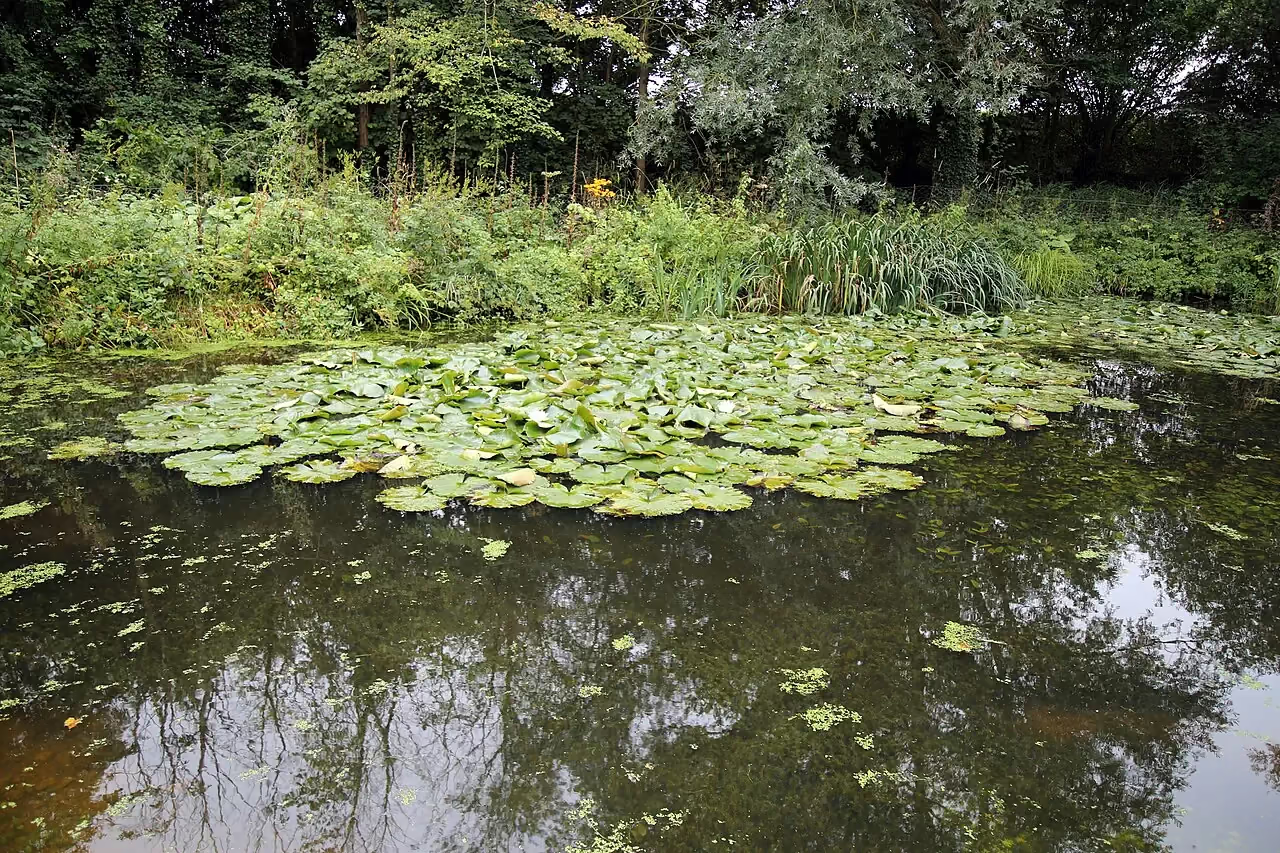
Introduction
The pond is one of the most generous elements of a permaculture system: it stores water, regulates temperature, draws in enormous biodiversity, dragonflies, amphibians, birds, crop beneficials, and can, as a bonus, become a small food zone. Well designed, it needs little upkeep and works for you all year.
Background
A well-drawn pond makes an ecosystem: it manages itself most of the time. Its first harvest is not the cattail, it is the biodiversity and water resilience it brings to the garden. The food function, through the controlled cultivation of cattail (Typha), is a bonus, subject to two non-negotiable golden rules: healthy water, and a contained plant.
Who this guide is for
Gardeners ready to invest a weekend of design and a little seasonal maintenance time. Especially suited to plots with a natural low point or a lightly shaded corner to make the most of.
Why it matters
A free water reserve (rainwater collected and stored), thermal regulation of the garden, a massive welcome for pollinators and beneficials (dragonflies, hoverflies, slug-eating amphibians), a potential food source (pollen, rhizomes, young cattail shoots), and a place of contemplation that changes your relationship with the garden.
What to understand before starting
- An available spot, ideally at a natural low point where water tends to gather.
- 5 to 6 hours of sun per day (enough light for aquatic life, no crushing full-south exposure that would make algae proliferate).
- Distance from large deciduous trees (dead leaves over-enrich the water and silt up the pond).
- Distance from pollution sources: roadside, runoff from sprayed crops, suspected old urban soils. A reinforced criterion for a food harvest.
- A rainwater harvester available for the initial fill and summer top-ups.
Detailed steps
- Step 1
Draw the tiered shape
The secret of a stable pond is a stepped profile: a deep zone of at least 60 to 80 cm, ideally 80 to 120 cm (a refuge for the fauna against winter frost and summer heat); marginal shelves of 20 to 40 cm for the bank plants; and a gently sloping bank ('beach') on at least one side. This beach, where water meets land, hosts varied life and lets hedgehogs, birds and amphibians get in and out without drowning. Even a small pond works if it respects these tiers.
- Step 2
Choose the waterproofing method
Three options depending on your soil and budget. Naturally present clay: if your soil is rich in clay, you can ram it (the gley technique) to make the bottom watertight, the most natural and durable solution, but it depends on the soil's nature. Bentonite: a swelling clay incorporated into the bottom to seal a leaking soil, a good compromise. EPDM liner: a flexible rubber, neutral for the fauna, that easily lasts 20 to 30 years (manufacturer data, Firestone, Carlisle), the most reliable option. Always protect it with a geotextile (felt) underneath and a thin layer of sand, to stop a root or a stone piercing it. Avoid PVC, less durable and less ecological.
- Step 3
Fill with rainwater, with clear eyes
Fill preferably with rainwater. Tap water is chlorinated and above all loaded with nitrates and phosphates, which feed algae and unbalance the pond from the start. If you only have tap water, let it stand a few days before introducing the plants (the chlorine evaporates in 48-72 h). BUT beware: the science of 2020-2024 has challenged the idea that 'rainwater is pure'. The Cousins study (2022, Environmental Science & Technology) showed that levels of PFOA (a 'forever chemical') in rainwater exceed US drinking-water health advisories even in remote regions, and PFOS levels often do; microplastics and atmospheric heavy metals are also detectable. Rain remains preferable to the mains for the pond, but the word 'impeccable' should be used with measure. See the 'Rainwater quality' concept for the detail.
- Step 4
Plant by tiers, native oxygenators first
Submerged oxygenating plants are essential: they produce oxygen and compete with algae. Favour hornwort (Ceratophyllum demersum) or spiked water-milfoil (Myriophyllum spicatum), native species. Absolutely avoid the invasive exotics banned by EU regulation 1143/2014 and the French order of 14 February 2018: water primrose (Ludwigia grandiflora and L. peploides), Crassula helmsii, Nuttall's waterweed (Elodea nuttallii), parrot's-feather (Myriophyllum aquaticum). Add floating plants (dwarf water lily, a controlled amount of duckweed) to shade the surface, and bank plants on the shelves (yellow flag iris, water mint, cattail in a container).
- Step 5
Aim for a vegetation balance of a third to a half
Aim in the long run for a third to a half of the surface covered by vegetation: it is the balance that limits the light available to filamentous algae, without smothering the open-water zone the fauna needs.
- Step 6
Be patient, life comes on its own
A pond takes one to two seasons to find its balance. Life comes on its own: dragonflies in a few days, amphibians in a few weeks, birds as soon as insects appear. Never introduce goldfish (Carassius auratus), they devour amphibian larvae and eggs and cloud the water. Nor introduce plants or animals taken from a wild pond, a health risk and a regulatory risk.
- Step 7
To grow edible cattail: submerged basket + impeccable water
Always plant the cattail (Typha latifolia or T. angustifolia) in a submerged basket or container, openwork pond baskets lined with jute, set on the marginal shelf 10-30 cm below the surface. You thus control its spread and can harvest it cleanly. For a food harvest, the pond must be fed with rainwater and away from any contamination source, see 'mistakes to avoid'. The ideal alternative: a separate basin dedicated to cattail (a reed-bed zone or watertight tank), both for controlled harvest and for its purifying qualities.
Common mistakes to avoid
- Harvesting cattail from water of unknown origin. Typha strongly accumulates heavy metals, mainly in its roots: that is why it is used in phytopurification (Brix, 1994; Bonanno and Cirelli, 2017). No washing removes these metals from the plant tissues. If in doubt about the water quality: keep the cattail for its ecological and purifying role, not for the plate.
- Leaving the cattail free in the pond. Its rhizomes spread fast and strong: left without a container, it colonises the whole pond in a few years, silts it up and ends up drying it out. Planting in a basket is non-negotiable.
- Introducing goldfish to 'liven up' the pond. They destroy the faunal balance and prevent amphibians from breeding.
- Choosing PVC rather than EPDM for waterproofing. Less durable, can release plasticisers, to be avoided for a food ecosystem.
- Filling with tap water without precaution. The nitrates and phosphates of mains water launch the pond with an excess of nutrients that will take months to clear.
Tips & best practices
- In autumn, stretch an anti-leaf net over the pond during the weeks of leaf fall: it is the act that most reduces the desilting work.
- Every 3 to 5 years, partly remove the silt in late summer or early autumn, never all at once. Leave the removed silt on the bank for 24 to 48 h: the trapped small fauna will return to the water.
- In summer, watch the water level and top up with stored rainwater, especially to protect the deep zone.
- A veil of filamentous algae in spring is normal, do not intervene straight away. If they take over durably, it is almost always a sign of excess nutrients: remove them by hand with a stick that you twirl, and rebalance with more oxygenating plants and shade.
- For cattail pollen, shake the yellow male spikes over a bag in early summer. You obtain a golden 'flour' rich in protein, to mix with ordinary flour for pancakes or bread.
- No room for a real pond? A simple water point, a zinc basin or an old tub filled with rainwater, with an oxygenating plant and a stone or twig breaking the surface so fallen insects can climb out, already draws dragonflies, birds and beneficial insects. Place it in partial shade and top it up with water in summer.
Frequently asked questions
- What is the minimum size for a pond to work?
- There is no strict minimum size: the larger a pond, the more wildlife it draws, but even a very small pond gives a home to plenty of small creatures (RHS). The profile matters more: depths that vary gradually and at least one gently sloping bank (RHS; LPO Auvergne-Rhône-Alpes).
- Do I need a pump or a filtration system?
- No, not for a natural pond. Filtration is only needed if you introduce fish (not advised). A balanced ecosystem with its oxygenating plants, its bank vegetation and its fauna regulates itself without energy.
- Can you eat the other pond plants?
- Water mint (Mentha aquatica) is edible under the same precautionary conditions as cattail, impeccable water required. Yellow flag iris, water lily: not edible, to be left for biodiversity and beauty.
- How long before you can harvest cattail?
- Count 2 to 3 years from planting to have rhizomes developed enough to harvest without exhausting the plant. The young shoots ('Cossack asparagus', a traditional name documented by Couplan) and the pollen can be taken from the second season.
- Does the pond attract mosquitoes?
- A balanced pond attracts no more mosquitoes than a forgotten bucket of water, on the contrary: mosquito larvae are devoured by dragonfly larvae, newts, backswimmers and several species of aquatic beetle. Ponds with goldfish or stagnant lifeless water attract many; living ponds host few.
Key takeaways
- A tiered profile (deep + shelves + beach) = the basis of a stable ecosystem.
- EPDM on geotextile = the best waterproofing for long-term use.
- Rainwater for the fill + native oxygenating plants = a natural anti-algae.
- Never goldfish, never plants taken from the wild.
- For edible cattail: planting in a basket and the cleanest possible water, knowing that no rainwater is pure.
- The detailed plant sheets: cattail, arrowhead, water chestnut, duckweed, watercress can be found in the library (category 'Aquatic & wetland').
Sources
- Cousins, I.T. et al. (2022). Outside the safe operating space of a new planetary boundary for per- and polyfluoroalkyl substances (PFAS). Environmental Science & Technology, 56(16), 11172-11179.
- Brix, H. (1994). Functions of macrophytes in constructed wetlands. Water Science and Technology, 29(4), 71-78.
- Bonanno, G. & Cirelli, G.L. (2017). Comparative analysis of element concentrations and translocation in three wetland congener plants: Typha domingensis, Typha latifolia and Typha angustifolia. Ecotoxicology and Environmental Safety, 143, 92-101.
- RHS (Royal Horticultural Society) : Wildlife ponds (rhs.org.uk/ponds/wildlife-ponds)
- LPO Auvergne-Rhône-Alpes : fiche Refuges LPO « Une mare naturelle au jardin »
- Couplan, F. Le régal végétal : plantes sauvages comestibles. Sang de la Terre.
- Règlement (UE) n° 1143/2014 du Parlement européen et du Conseil du 22 octobre 2014 relatif aux espèces exotiques envahissantes
- Arrêté du 14 février 2018 relatif à la prévention de l'introduction et de la propagation des espèces végétales exotiques envahissantes sur le territoire métropolitain