In the pathway: Water and living soil
Managing water in the garden
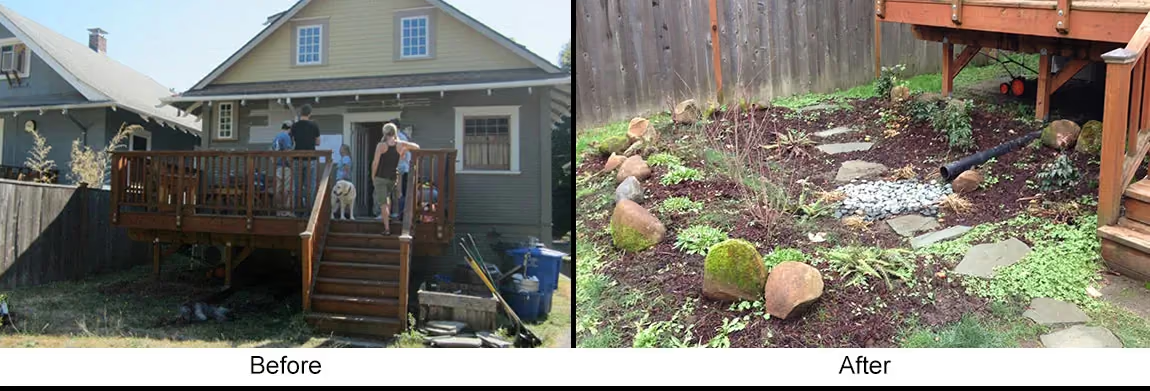
Slow, infiltrate, store and gently spread water across the plot.
Introduction
Water is the most precious and most uneven resource in a changing climate: too much in winter, missing in summer. Permaculture water management rests on a simple principle: slow, infiltrate, store, spread, instead of draining away.
Background
On a conventional plot, a large share of the rainwater runs off or evaporates; a well-designed plot holds much more, creating reserves for dry spells and limiting erosion during storms.
Who this guide is for
Any gardener or owner facing summer droughts, violent storms or soil that dries out fast. Especially useful on sloping ground.
Why it matters
Greatly reduces watering needs. Prevents erosion. Recharges the groundwater. Creates cooler microclimates. Multiplies biodiversity (a pond = an explosion of life).
What to understand before starting
- Know the local rainfall and the direction of the slope (spirit level, A-frame).
- The roof area measured (1 m² × 1 mm of rain = 1 L recoverable).
- Tools: spade, level, transparent garden hose or laser level to trace the contour lines.
Detailed steps
- Step 1
Collect roof water
Install a 500 to 5000 L tank depending on the roof area. 1000 L per 50 m² of roof is a comfortable minimum. A leaf filter at the inlet.
- Step 2
Direct the overflows
Rather than sending the overflow to the drain, direct it to a planted bed or an infiltration swale.
- Step 3
Trace the contour lines
With an A-frame or a water-filled garden hose: trace the horizontal lines across the slope. It is on these lines that you dig swales and plant.
- Step 4
Dig swales
A trench 30-50 cm deep, 50-80 cm wide, following the contour. The downhill bank is planted with trees or shrubs. Stops and infiltrates the runoff.
- Step 5
Create a pond
A gently sloping hole (zones at 5/20/50/100 cm), EPDM liner or compacted clay, aquatic plants. Stores, cools, draws in biodiversity.
- Step 6
Mulch everywhere
5 to 10 cm of straw or RCW on all bare soil, coarser materials at the top of the range; fresh grass clippings in thin layers left to dry, because in a thick layer they mat and let water and air through poorly. An organic mulch covering the soil clearly limits evaporation from its surface: FAO uses a reduction of about 5 % for every tenth of the surface covered, roughly half for fully covered soil (FAO Irrigation and Drainage Paper 56). The plant keeps transpiring: mulch spaces out watering, it does not remove the plant's water needs.
Concrete examples
Common mistakes to avoid
- A tank placed in the sun without an airtight lid: mosquitoes + algae.
- A swale dug by eye without a level: the water flows out at one point and erodes.
- A pond liner laid without a sand layer to protect it: quick puncture by stones or roots.
- Sprinkler watering in daytime: wind and evaporation carry off part of the water (about 15 % by day in measurements under a semi-arid climate, markedly less at night, Playán et al., 2005), and foliage that stays wet for hours favours blight (RHS).
Frequently asked questions
- Do you need a permit for a tank?
- No in France for outdoor use. For indoor use (toilets), yes (town hall + certified plumber).
- Is tank water drinkable?
- No. It is fine for watering, cleaning, and with filtration for toilets and washing machines.
- A swale in clay soil?
- Harder: dig shallower and wider, and plant on the bank so the roots pierce the layer.
Sources
- Allen, R.G., Pereira, L.S., Raes, D. & Smith, M. (1998). Crop evapotranspiration: guidelines for computing crop water requirements. FAO Irrigation and Drainage Paper 56. Rome : FAO.
- Playán, E. et al. (2005). Day and night wind drift and evaporation losses in sprinkler solid-sets and moving laterals. Agricultural Water Management, 76(3), 139-159.
- RHS (Royal Horticultural Society) : Watering plants wisely (rhs.org.uk/garden-jobs/watering)
- RHS (Royal Horticultural Society) : Mulches and mulching (rhs.org.uk/soil-composts-mulches/mulch)
- Iowa State University Extension and Outreach : Using Mulch in the Garden (yardandgarden.extension.iastate.edu/how-to/using-mulch-garden)
- Colorado State University Extension (Whiting D., O'Meara C. & Wilson C.) : Mulches for the Vegetable Garden (extension.colostate.edu/resource/mulches-for-the-vegetable-garden/)