Potato late blight
Phytophthora infestans
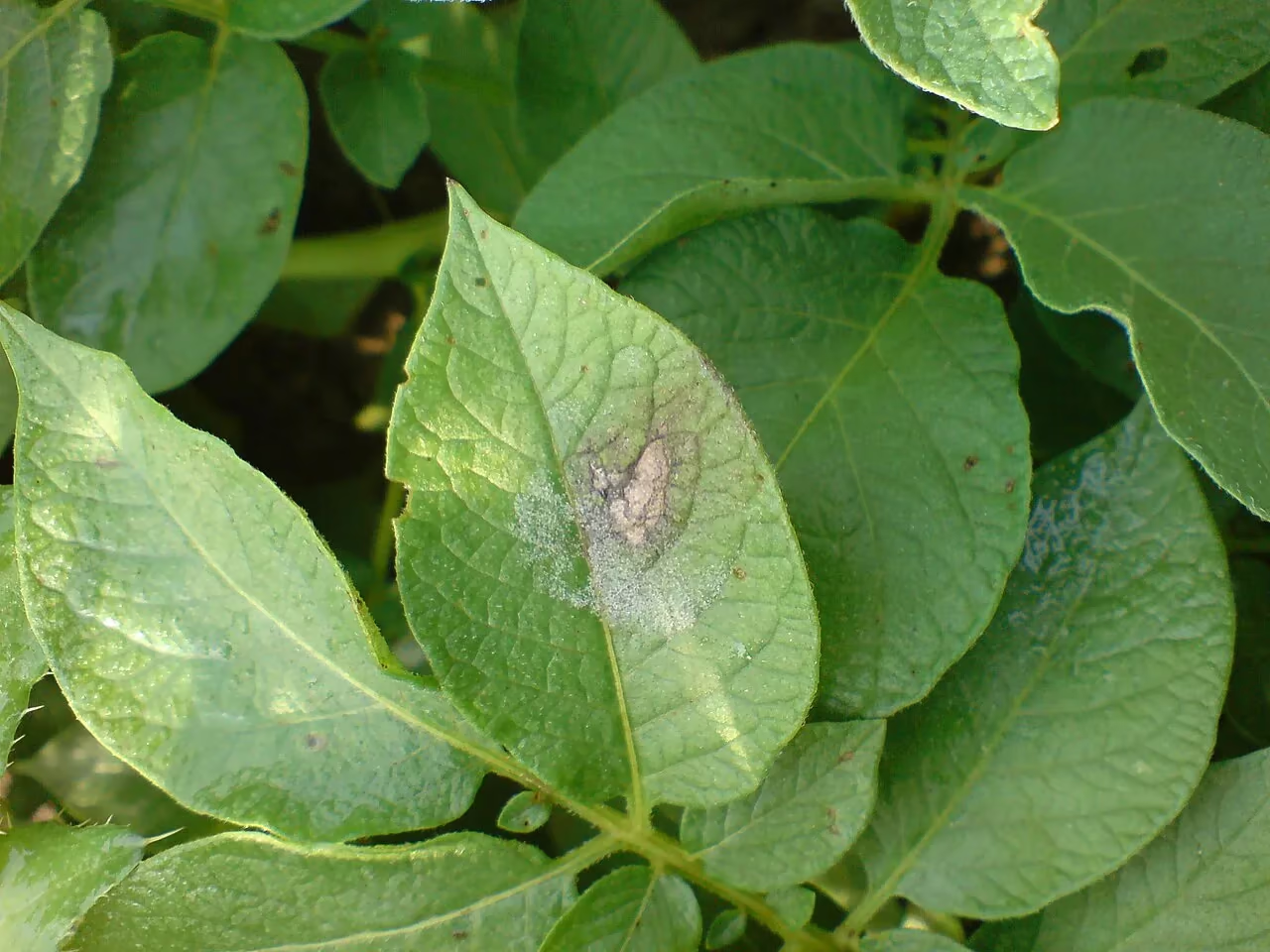
Late blight (Phytophthora infestans): an oily brown patch ringed with a fine white-grey down (sporulation), here on a potato leaf, in mild, very humid weather.
Photo: Björn Andersson (SLU) · CC BY-SA 4.0 · source
Role in the garden
A disease caused by an oomycete (Phytophthora infestans), a micro-organism often grouped with the fungi; devastating in a wet summer, it destroys foliage and then tubers in a few days.
Practical guide
Prevention
Choose the most resistant varieties: “Eden”, “Carolus”, “Sarpo Mira” for the potato. Space the plants for air; mulch to avoid splashing; water at the base, never on the foliage. Blight overwinters in infected tubers left in the ground: lift every forgotten potato before spring, and do not compost affected haulm or tubers (RHS).
Early signs
In summer, after mild, very humid days (rain, dew, fog), brown spots appear on the leaves. The plants collapse and eventually die; a white-grey down may appear on the underside of the leaves.
Action / control
You can only hope to limit the damage. Cut the potato stems as soon as it appears to save the tubers. Cut the attacked tomato leaves to slow the progression. Preventively: Bordeaux mixture at a moderate dose; copper builds up in the soil, and the European Union limits its use to 28 kg per hectare over 7 years, i.e. on average 0.4 g of copper per m² per year: read the copper content on the label and never exceed the stated dose. Horsetail decoction, often cited, did not protect tomatoes or potatoes in French trials (SNHF, 2012).
Plants affected
Sources
- Ephytia, INRAE : Tropilég, Mildiou des Solanacées (P. infestans)
- RHS (Royal Horticultural Society) : Potato and tomato blight (rhs.org.uk/disease/potato-and-tomato-blight)
- SNHF, Conseil scientifique (2012). Protection des plantes, tradition et macération d'ortie
- Règlement d'exécution (UE) 2018/1981 de la Commission renouvelant l'approbation des composés de cuivre (considérant 15 et annexe)
Related plant entries
Potato
A nightshade with traditional planting (April) or grown under mulch (Charles Dowding) requiring zero earthing-up. Demanding in manure, it readily heads the rotation on an enriched bed (GAB/FRAB Bretagne). Not to follow or precede a tomato on the same bed (shared blight, Phytophthora infestans).
Tomato
Central plant of the tomato guild. The neighbouring basil is reputed to hinder aphids through its volatile compounds.
Spotted a mistake on this page?Write to us