In the pathway: Water and living soil
Living soil
The network of organisms (bacteria, fungi, worms) that makes the soil fertile.
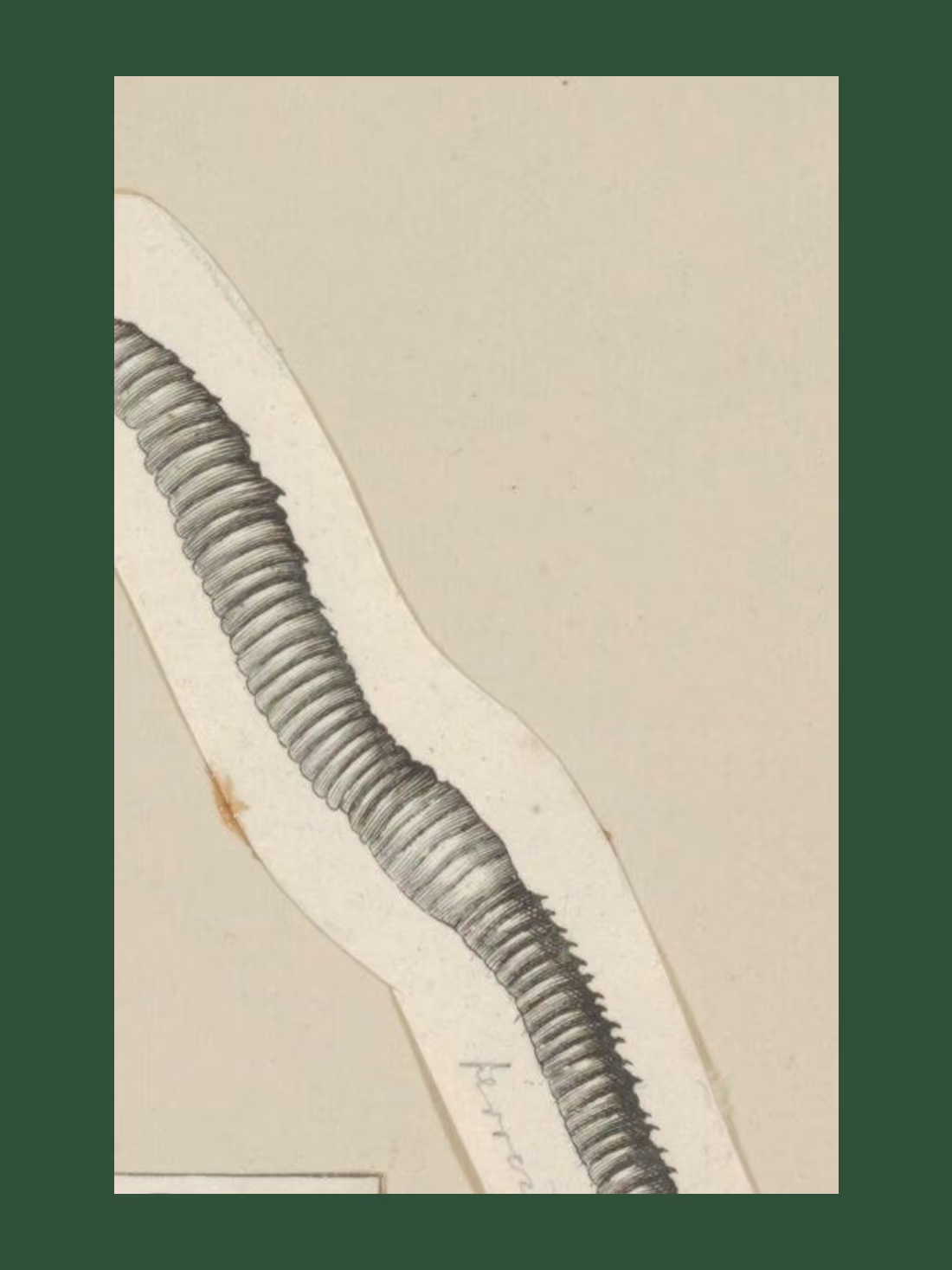
The earthworm, a builder of living soil: it digs burrows that let air into the earth, draws organic matter down into them and turns it into a fertile humus.
Drawing: Iconographia Zoologica (Univ. d'Amsterdam, XIXᵉ s.) · Domaine public · source
Explanation
A living soil rests on the balance between organic matter, permanent living roots, mycorrhizal fungi, bacteria and fauna. Intensive tillage damages these networks; permanent cover, mulch and plant diversity encourage them. A concept popularised in France by Claude and Lydia Bourguignon (LAMS, Laboratory for Microbiological Soil Analysis), and in the United States by Elaine Ingham (Soil Food Web).
Refined definition
One gram of fertile soil holds hundreds of millions of bacteria, not counting fungi, protozoa, nematodes, earthworms and arthropods. It is this living biomass that turns plant residues into humus and available nutrients. A “dead” soil (intensively ploughed, without fresh organic matter, under chemical fertilisers) still harbours microorganisms but has lost its structure and its key interactions.
Key points
The main actors
BACTERIA: generally 100 million to 1 billion per gram of soil (USDA NRCS, Soil Biology Primer), they decompose simple organic matter and release mineralised nutrients. FUNGI: their mycelium structures the soil through glomalin (a sticky protein that binds the particles), feed the plants via the mycorrhizae, decompose lignin (which bacteria cannot break down). EARTHWORMS: dig burrows, mix and aerate the soil, produce casts. NEMATODES, PROTOZOA, MITES: regulate the bacterial and fungal populations. Sources: Lydia and Claude Bourguignon, Le sol, la terre et les champs, Sang de la Terre, 2008; Soil Biology Primer (USDA NRCS).
The fungi / bacteria ratio (F/B)
The ratio of fungi to bacteria varies with the habitat: close to 1 to 1, or a little less, in productive farm soils, 5 to 10 to 1 in broadleaf forest and far more in conifer forest (USDA NRCS, Soil Biology Primer). With reduced tillage, it tends to rise over the years. These values describe habitats, not targets to reach.
How to regenerate a dead soil
Step 1: stop deep working (ploughing, rotavating). Step 2: cover the soil permanently (organic mulch at least 5 cm thick, according to the RHS). Step 3: keep living roots all year round (winter green manures). Step 4: bring in varied organic matter (mature compost, RCW, straw). Step 5: avoid soluble chemical inputs. Visible results after a few years: more earthworms, a crumbly structure, accelerated water infiltration.
Watch out for
- • “Living soil” has become a marketing slogan, some commercial products (“soil activators”, miracle inoculants) are not scientifically validated. Prefer concrete inputs (compost, mulch) over sprays.
- • The spade test: pushing a spade into a living soil should be easy, the soil should crumble into crumb-like aggregates when you turn it over, and worms should appear. A soil that sounds hollow or splits cleanly is dead at the surface.
- • Mature forest soil is an unattainable goal in the vegetable garden (geological timescale), aim instead for a stable, structured, fertile soil, not the “original forest soil”.
Examples
- • Root exudates feeding the microbial flora
- • Glomalin (fungi) → stable aggregates
- • Earthworms → burrows and casts
- • Permanent cover
- • Fungi / bacteria ratio: a reflection of the habitat
Sources
- USDA NRCS & Soil and Water Conservation Society (2000). Soil Biology Primer (éd. révisée). Ankeny : SWCS.
- Bourguignon, C. & Bourguignon, L. (2008). Le sol, la terre et les champs. Paris : Sang de la Terre.
- Blouin, M. et al. (2013). A review of earthworm impact on soil function and ecosystem services. European Journal of Soil Science, 64(2), 161-182.
- RHS (Royal Horticultural Society) : Mulches and mulching (rhs.org.uk/soil-composts-mulches/mulch)