In the pathway: Water and living soil
Living soil
The network of organisms (bacteria, fungi, worms) that makes the soil fertile.
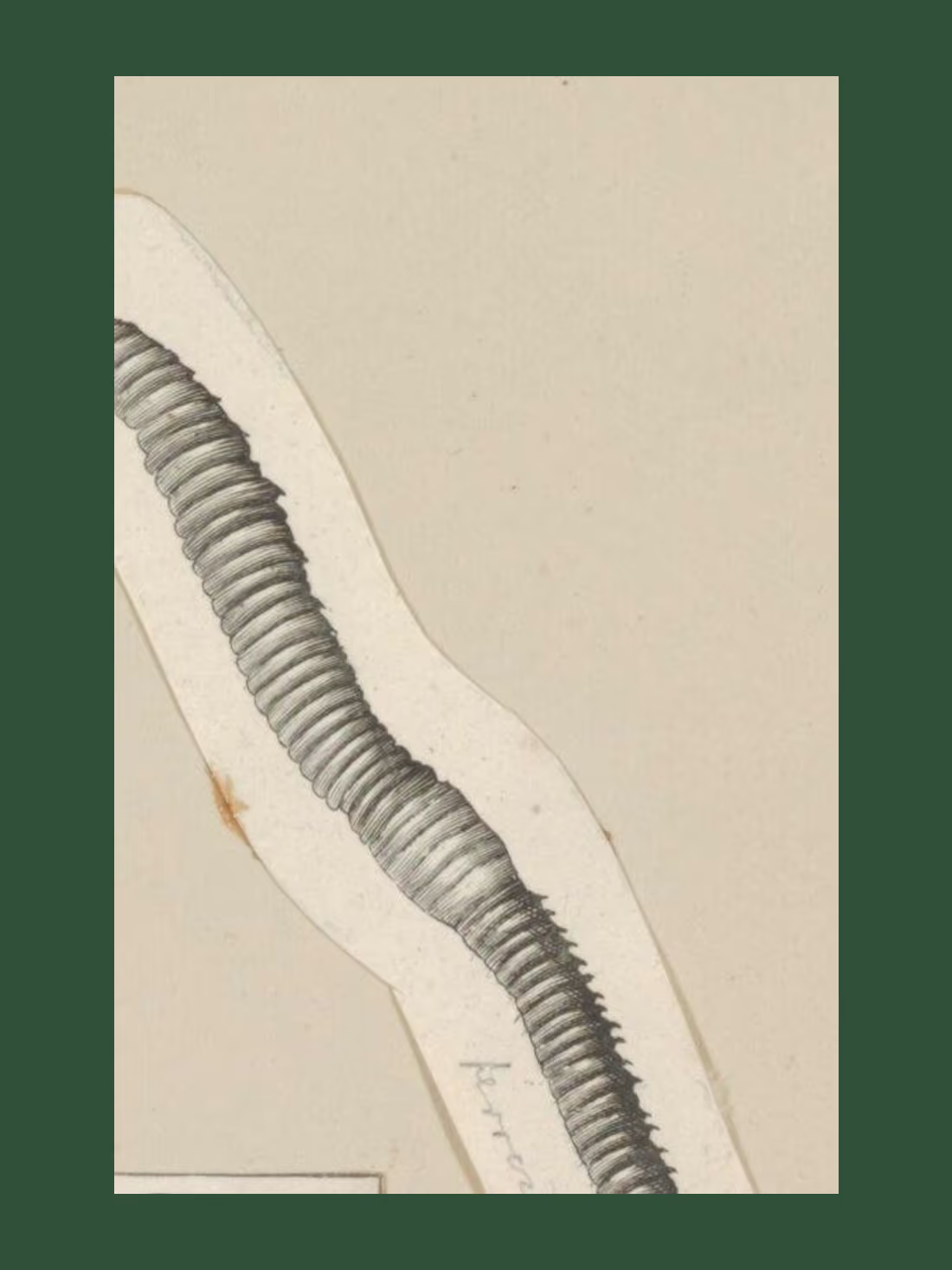
The earthworm, a builder of living soil: it digs burrows that let air into the earth, draws organic matter down into them and turns it into a fertile humus.
Drawing: Iconographia Zoologica (Univ. d'Amsterdam, XIXᵉ s.) · Domaine public · source
Explanation
A living soil rests on the balance between organic matter, permanent living roots, mycorrhizal fungi, bacteria and fauna. Intensive tillage damages these networks; permanent cover, mulch and plant diversity encourage them. A concept popularised in France by Claude and Lydia Bourguignon (LAMS, Laboratory for Microbiological Soil Analysis), and in the United States by Elaine Ingham (Soil Food Web).
Refined definition
Fertile soil holds hundreds of millions of bacteria per teaspoon, not counting fungi, protozoa, nematodes, earthworms and arthropods. It is this living biomass that turns plant residues into humus and available nutrients. A “dead” soil (intensively ploughed, without fresh organic matter, under chemical fertilisers) still harbours microorganisms but has lost its structure and its key interactions.
Key points
The main actors
BACTERIA: a teaspoon of productive soil generally holds 100 million to 1 billion of them (USDA NRCS, Soil Biology Primer); they decompose simple organic matter and release mineralised nutrients. FUNGI: their mycelium takes part in the soil's structure (notably through glomalin, a soil substance associated with aggregation, whose nature and mode of action are still debated), feeds the plants via the mycorrhizae, breaks down lignin (which bacteria break down poorly). EARTHWORMS: dig burrows, mix and aerate the soil, produce casts. NEMATODES, PROTOZOA, MITES: regulate the bacterial and fungal populations. Sources: Lydia and Claude Bourguignon, Le sol, la terre et les champs, Sang de la Terre, 2008; Soil Biology Primer (USDA NRCS).
The fungi / bacteria ratio (F/B)
The ratio of fungi to bacteria varies with the habitat: close to 1 to 1, or a little less, in productive farm soils, 5 to 10 to 1 in broadleaf forest and far more in conifer forest (USDA NRCS, Soil Biology Primer). With reduced tillage, it tends to rise over the years. These values describe habitats, not targets to reach.
How to regenerate a dead soil
Step 1: stop deep working (ploughing, rotavating). Step 2: cover the soil permanently (organic mulch at least 5 cm thick, according to the RHS). Step 3: keep living roots all year round (winter green manures). Step 4: bring in varied organic matter (mature compost, RCW, straw). Step 5: avoid soluble chemical inputs. Visible results after a few years: more earthworms, a crumbly structure, accelerated water infiltration.
Watch out for
- • “Living soil” has become a marketing slogan, some commercial products (“soil activators”, miracle inoculants) are not scientifically validated. Prefer concrete inputs (compost, mulch) over sprays.
- • The spade test: pushing a spade into a living soil should be easy, the soil should crumble into crumb-like aggregates when you turn it over, and worms should appear. A compact clod, with no crumbs, roots or worms, points to a compacted soil or one poor in life. But a clay soil, however alive, bakes hard and cracks in summer (RHS): that sign says nothing about its life.
- • Mature forest soil is an unattainable goal in the vegetable garden (geological timescale), aim instead for a stable, structured, fertile soil, not the “original forest soil”.
Examples
- • Root exudates feeding the microbial flora
- • Glomalin (fungi): a link with soil aggregation, still debated
- • Earthworms → burrows and casts
- • Permanent cover
- • Fungi / bacteria ratio: a reflection of the habitat
Sources
- USDA NRCS & Soil and Water Conservation Society (2000). Soil Biology Primer (éd. révisée). Ankeny : SWCS.
- Bourguignon, C. & Bourguignon, L. (2008). Le sol, la terre et les champs. Paris : Sang de la Terre.
- Blouin, M. et al. (2013). A review of earthworm impact on soil function and ecosystem services. European Journal of Soil Science, 64(2), 161-182.
- RHS (Royal Horticultural Society) : Mulches and mulching (rhs.org.uk/soil-composts-mulches/mulch)
- Irving, T.B. et al. (2021). A critical review of 25 years of glomalin research: a better mechanical understanding and robust quantification techniques are required. New Phytologist, 232, 1572-1581. DOI 10.1111/nph.17713
Spotted a mistake on this page?Write to us