Ground-cover plants
Avoid leaving the soil bare: it erodes and dries out.
Introduction
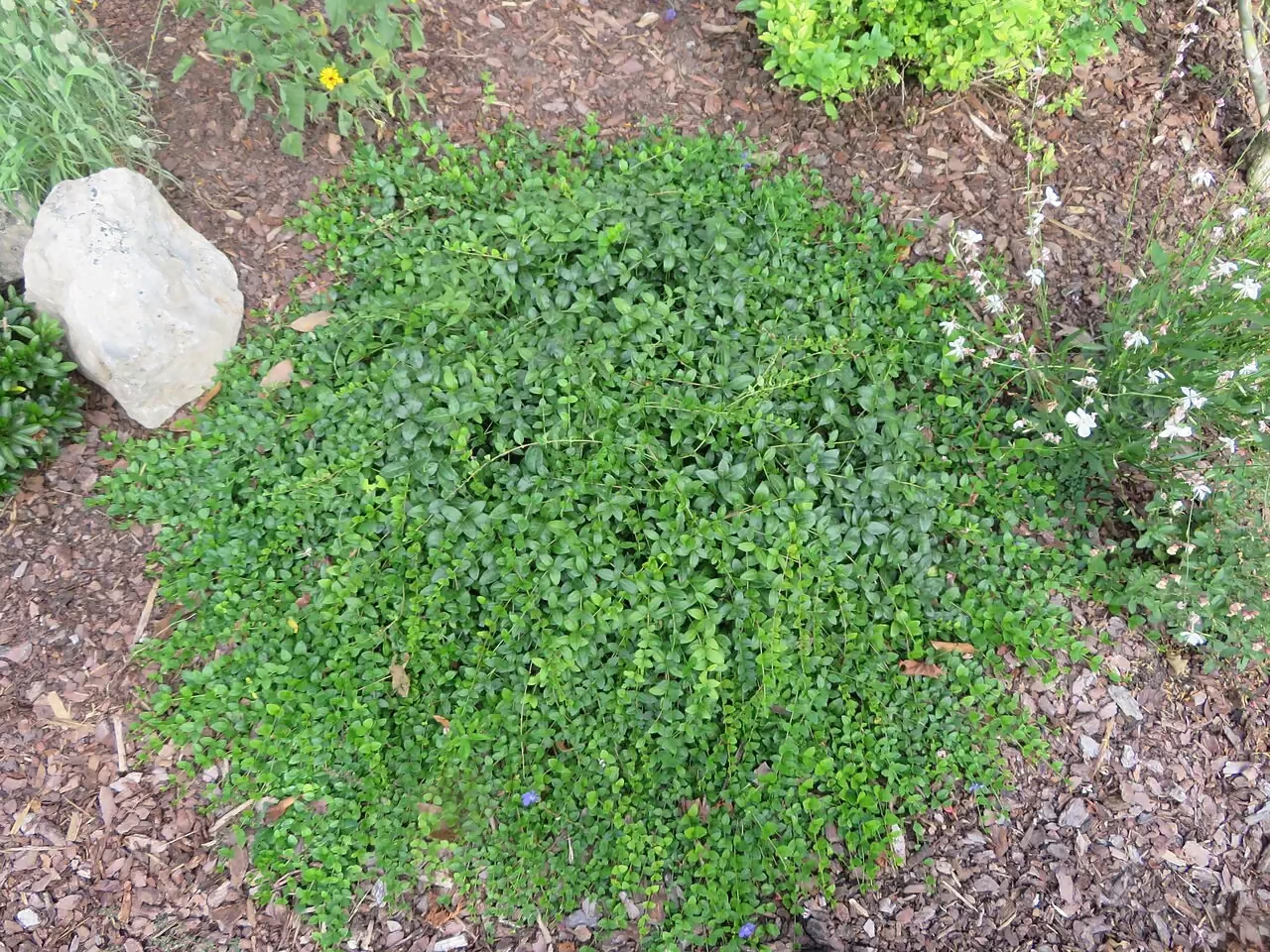
Left bare, soil dries out and erodes under heavy rain. Ground-cover plants, or green manures, are the living coat that protects it between two crops.
Background
Nature never leaves soil without vegetation: fallow land, meadow, woodland floor, something is always growing. In conventional farming, bare soil between two crops is a dead loss. In permaculture, we set up covers suited to the season and the soil.
Who this guide is for
Any gardener wishing to improve their soil's fertility without inputs. Especially useful on poor, compacted or transitioning soils.
Why it matters
Greatly reduces erosion (a living cover protects the soil from beating rain and runoff). Limits weeds (shade, allelopathy). Cover legumes typically fix several tens of kg of nitrogen per hectare. Feeds the soil life (worms, mycorrhizae, bacteria) and stores carbon.
What to understand before starting
Detailed steps
- Step 1
Identify the sowing window
Any bed freed for 4 weeks or more deserves a cover. Note these windows in your annual plan.
- Step 2
Choose the species for the season
Summer (March–August): phacelia, buckwheat, Alexandrian clover. Autumn–winter: crimson clover sown from late August to mid-September, rye and vetch in September–October. Permanent: white clover, thyme, strawberry.
- Step 3
Broadcast-sow
Prepare a lightly raked soil. Broadcast the seed, rake to bury, firm with the back of the rake, water with a fine spray.
- Step 4
Let it grow
Depending on the species, 6 to 12 weeks. Ideally, cut just before flowering to maximise biomass.
- Step 5
Cut and leave in place
Cut at the base, let dry for 2 to 3 days, then use as mulch in place or elsewhere. Do not bury: let the worms do it.
- Step 6
Plant or sow the next crop
Wait 2 to 3 weeks after cutting to limit nitrogen lock-up, longer if the cover was old or strawy. Sow or plant directly through the mulch.
Concrete examples
Common mistakes to avoid
- Letting the cover go to seed: it becomes a weed.
- Burying the cover deep: it suffocates the soil and locks up nitrogen.
- Choosing a species of the same family as the next crop (e.g. mustard before cabbages).
- Sowing too late in autumn: rye sows until 15 October, phacelia and crimson clover until 15 September.
Frequently asked questions
- Is bare soil, mulched, enough?
- It is better than nothing, but a living cover feeds the microfauna and stores carbon, which mulch alone does not.
- Do I need to plough afterwards?
- No. Cut at the base and plant through the mulch, or use a broadfork if the soil is very compacted.
- Do covers attract slugs?
- Yes on damp soil. Cutting 3 weeks before the next crop gives them time to disperse.
Sources
- RHS (Royal Horticultural Society) : Green manures (rhs.org.uk/soil-composts-mulches/green-manures)
- Clark, A. (dir.) (2007). Managing Cover Crops Profitably (3e éd.). Sustainable Agriculture Research and Education (SARE).
- Pousset, J. (2002). Engrais verts et fertilité des sols. Paris : France Agricole.
- SEMAE (ex-GNIS) : Trèfle incarnat, fiche « Cultivons la diversité des plantes cultivées », février 2008 (semencemag.fr)
- FNAMS (Bouviala M., Bouet S. & Deneufbourg F.) : Trèfle incarnat porte-graine, fiche culturale, octobre 2022 (fnams.fr/trefle-incarnat-porte-graine/)