In the pathway: Getting started in permaculture
The Three Sisters
Maize, bean, squash: three plants that help one another on the same mound.
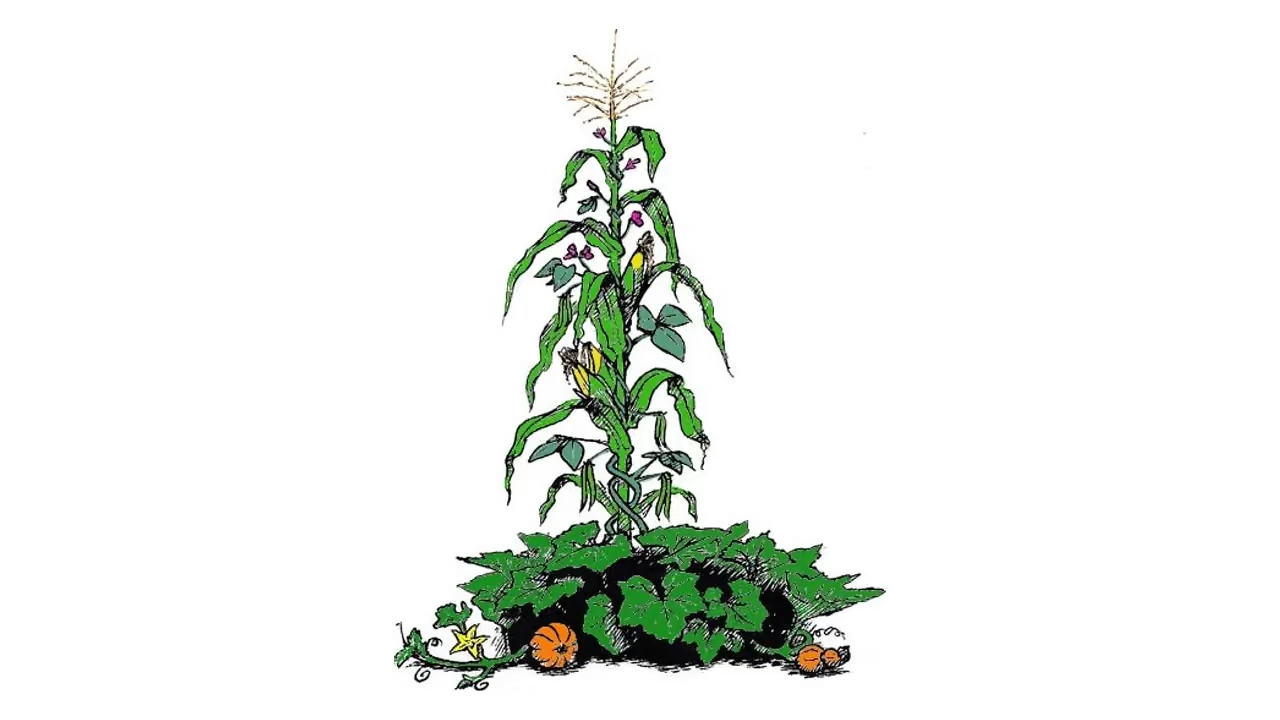
The guild's plates
Introduction
The corn-bean-squash association is age-old and widespread throughout the Americas: in the south, the Mesoamerican milpa; in the north-east, the 'Three Sisters' of the Haudenosaunee peoples. It is a perfect illustration of the permaculture principle of beneficial associations: three crops complement each other in time and space to produce more from the same area, with less watering and weeding.
Background
The maize acts as a living stake, the climbing bean fixes atmospheric nitrogen through its root nodules, and the squash covers the ground with its wide leaves, keeping moisture in and smothering weeds. This trio forms a small ecosystem on a single mound.
Who this guide is for
Beginner or experienced gardeners with a sunny vegetable patch of at least 1.5 m². Suited to almost all of mainland France.
Why it matters
Soil explored more fully (maize roots nearest the surface, the bean a little deeper, and the squash deepest of all, so the three share the soil layers between them, Zhang et al., 2014), water savings (the squash covers the ground and greatly reduces evaporation), space savings (3 harvests on the same area), resilience (in a heatwave, the squash protects the soil).
What to understand before starting
- A full-sun spot, sheltered from strong winds.
- Loose soil, worked to 30 cm, enriched with mature compost.
- Soil temperature > 15 °C (generally after mid-May in northern France).
- Suitable varieties: a tall-stemmed maize, preferably harvested ripe for grain (flour, polenta) and not F1 hybrid; a sweetcorn picked fresh on the cob works too, but it is far less nourishing than a ripe maize. Climbing bean (not dwarf); trailing squash (red kuri, butternut).
Detailed steps
- Step 1
Prepare the mound
Form a mound 80 cm to 1 m wide, 15 to 20 cm high. Work in 1 to 2 buckets of mature compost per square metre. The domed shape drains excess water and warms the soil.
- Step 2
Sow the maize
In the centre, sow 4 to 6 maize kernels in a staggered pattern, 25 cm apart, 3 cm deep. Water. Grouped sowing ensures good cross-pollination (maize is wind-pollinated).
- Step 5
Sow the squash on one side
On one side of the mound, sow 2 or 3 squash seeds, then keep only the most vigorous plant: a single trailing squash can cover 4 to 6 m², far more than the mound itself. Let its stems spread over the ground around the mound; one plant per mound is enough.
- Step 6
Mulch generously
As soon as they emerge, cover the bare soil with 5 to 10 cm of straw, hay or dry clippings. This limits evaporation and feeds the soil.
- Step 7
Tend and harvest
Water regularly the first month, then cut back. Pick the green beans through the summer; the maize according to its variety, sweetcorn when the silks turn brown, grain maize at full maturity; the squash before the first frosts, or under protection (straw, fleece) if frost threatens, as a frosted squash will not store; cut it leaving 10 cm of stem or more.
Concrete examples
Common mistakes to avoid
- Sowing bean and maize at the same time: the bean climbs too fast and breaks the young maize.
- Choosing a dwarf bean instead of a climbing one: it won't use the living stake.
- Putting several trailing squash on the same mound: they smother each other and everything else.
- Adding too much nitrogen (fresh manure): the maize lodges, the bean makes lots of leaves and few pods.
- Forgetting to mulch: the soil crusts, water runs off, the squash suffers.
Tips & best practices
- Soak the bean seeds for 12 h in lukewarm water before sowing to speed up emergence.
- Add an edging of nasturtium or pot marigold to draw in pollinators and beneficial insects.
- Save your best seeds: the Three Sisters are historically reproducible peasant varieties.
Frequently asked questions
Key takeaways
- The maize is a stake, the bean fixes nitrogen, the squash protects the soil.
- Stagger the sowings: maize first, bean when the maize is 15 cm.
- Mulch thick, keep a single squash plant per mound, choose non-F1 varieties.
Sources
- Mt. Pleasant, J. (2006). The science behind the Three Sisters mound system: an agronomic assessment of an indigenous agricultural system in the northeast. In Staller, J.E., Tykot, R.H. & Benz, B.F. (dir.), Histories of Maize (p. 529-537). Academic Press.
- Mt. Pleasant, J. (2016). Food yields and nutrient analyses of the Three Sisters: a Haudenosaunee cropping system. Ethnobiology Letters, 7(1).
- Zhang, C., Postma, J.A., York, L.M. & Lynch, J.P. (2014). Root foraging elicits niche complementarity-dependent yield advantage in the ancient 'three sisters' (maize/bean/squash) polyculture. Annals of Botany, 114(8), 1719-1733.
- RHS : « How to grow pumpkins » (rhs.org.uk/vegetables/pumpkins/grow-your-own)
Spotted a mistake on this page?Write to us