In the pathway: Getting started in permaculture
The Three Sisters
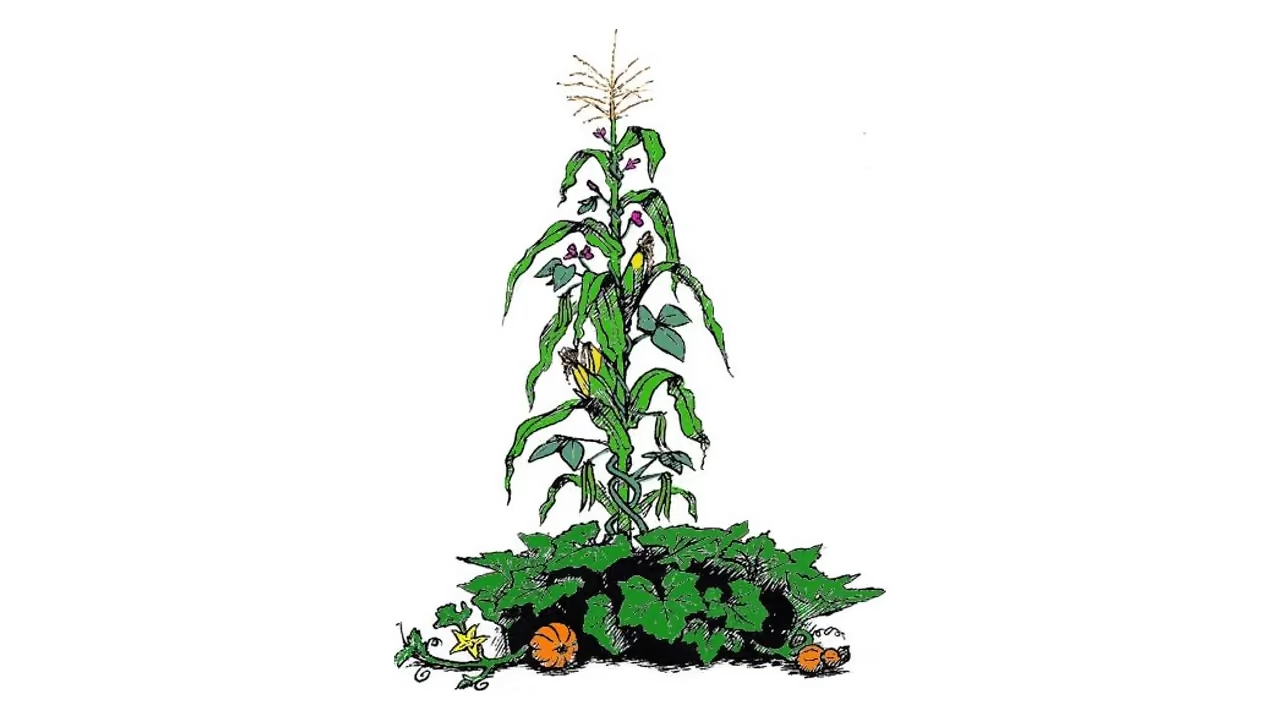
Maize, bean, squash: three plants that help one another on the same mound.
The guild's plates
Introduction
The milpa, or 'Three Sisters', is an age-old association developed by the peoples of Mesoamerica. It is a perfect illustration of the permaculture principle of beneficial associations: three crops complement each other in time and space to produce more from the same area, with less watering and weeding.
Background
The maize acts as a living stake, the climbing bean fixes atmospheric nitrogen through its root nodules, and the squash covers the ground with its wide leaves, keeping moisture in and smothering weeds. This trio forms a small ecosystem on a single mound.
Who this guide is for
Beginner or experienced gardeners with a sunny vegetable patch of at least 1.5 m². Suited to almost all of mainland France.
Why it matters
Soil explored more fully (maize forages nearer the surface, the bean more evenly down the profile, Zhang et al., 2014), water savings (the squash covers the ground and greatly reduces evaporation), space savings (3 harvests on the same area), resilience (in a heatwave, the squash protects the soil).
What to understand before starting
- A full-sun spot, sheltered from strong winds.
- Loose soil, worked to 30 cm, enriched with mature compost.
- Soil temperature > 15 °C (generally after mid-May in northern France).
- Suitable varieties: a tall-stemmed maize harvested ripe for grain (flour, polenta), not F1 hybrid (a sweetcorn, picked immature, is far less nourishing); climbing bean (not dwarf); trailing squash (red kuri, butternut).
Detailed steps
- Step 1
Prepare the mound
Form a mound 80 cm to 1 m wide, 15 to 20 cm high. Work in 1 to 2 buckets of mature compost per square metre. The domed shape drains excess water and warms the soil.
- Step 2
Sow the maize
In the centre, sow 4 to 6 maize kernels in a staggered pattern, 25 cm apart, 3 cm deep. Water. Grouped sowing ensures good cross-pollination (maize is wind-pollinated).
- Step 5
Sow the squash around the edge
All around the mound, sow 2 or 3 squash seeds at least 80 cm apart. A single trailing squash can cover 4 to 6 m². Limit to 1 plant per mound.
- Step 6
Mulch generously
As soon as they emerge, cover the bare soil with 5 to 10 cm of straw, hay or dry clippings. This limits evaporation and feeds the soil.
Concrete examples
Common mistakes to avoid
- Sowing bean and maize at the same time: the bean climbs too fast and breaks the young maize.
- Choosing a dwarf bean instead of a climbing one: it won't use the living stake.
- Putting several trailing squash on the same mound: they smother each other and everything else.
- Adding too much nitrogen (fresh manure): the maize lodges, the bean makes lots of leaves and few pods.
- Forgetting to mulch: the soil crusts, water runs off, the squash suffers.
Tips & best practices
- Soak the bean seeds for 12 h in lukewarm water before sowing to speed up emergence.
- Add an edging of nasturtium or pot marigold to draw in pollinators and beneficial insects.
- Save your best seeds: the Three Sisters are historically reproducible peasant varieties.
Frequently asked questions
- Can I grow the Three Sisters in a pot?
- Hard: the squash needs a lot of room. For a balcony, swap the squash for a climbing nasturtium, keeping the maize and the climbing bean.
- Do I need to water?
- Yes the first month, then only during very dry spells. The mulch and the squash do the work.
- What about slugs on the young squash?
- Mulch with a ring of ash or coffee grounds around the seedlings for the first few weeks.
Sources
- Mt. Pleasant, J. (2006). The science behind the Three Sisters mound system: an agronomic assessment of an indigenous agricultural system in the northeast. In Staller, J.E., Tykot, R.H. & Benz, B.F. (dir.), Histories of Maize (p. 529-537). Academic Press.
- Mt. Pleasant, J. (2016). Food yields and nutrient analyses of the Three Sisters: a Haudenosaunee cropping system. Ethnobiology Letters, 7(1).
- Zhang, C., Postma, J.A., York, L.M. & Lynch, J.P. (2014). Root foraging elicits niche complementarity-dependent yield advantage in the ancient 'three sisters' (maize/bean/squash) polyculture. Annals of Botany, 114(8), 1719-1733.