Powdery mildew
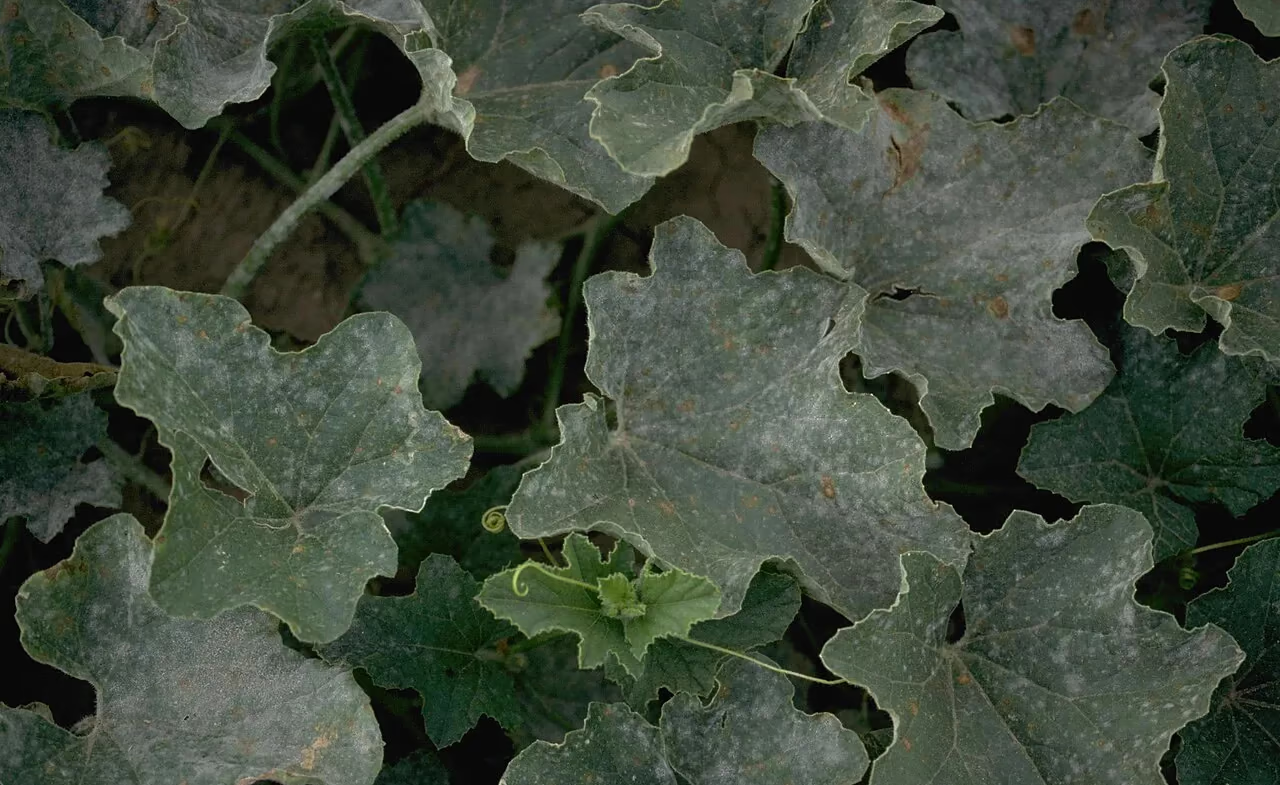
Powdery mildew: a white, powdery felt on the upper side of the leaves, here on melon, spreading and then drying them out.
Role in the garden
A fungus that covers the leaves with a white, flour-like felt until they dry out.
Practical guide
Prevention
Water susceptible plants regularly, right to the end of the season, so that they keep up vigorous growth; thin the foliage so the air circulates better; avoid watering the leaves in the evening.
Early signs
A white, sometimes greyish dust appears on some leaves and spreads rapidly to all of them. It generally shows at the end of the season, often in autumn, when the roots are short of water but the air stays humid.
Action / control
Pick the diseased leaves quickly to slow the progression. Throw them out with the household waste, as powdery mildew can survive the winter. Sprays of diluted milk or bicarbonate of soda are reputed to be preventive. In French trials, sulphur protected melons and artichokes from powdery mildew, where horsetail, nettle and comfrey preparations did nothing (SNHF, 2012): choose a product authorised for gardens and follow its label.
Plants affected
Sources
- RHS (Royal Horticultural Society) : Powdery mildews (rhs.org.uk/disease/powdery-mildews)
- SNHF, Conseil scientifique (2012). Protection des plantes, tradition et macération d'ortie
Related plant entries
Courgette (zucchini)
A cucurbit (Cucurbita pepo) with separate male and female flowers on the same plant, dependent on bees and bumblebees for cross-pollination, hence the value of companion flowers nearby. Sow in pots in April or in place after the last frosts (mid-May), in rich soil well supplied with compost. Its large leaves quickly cover the ground and limit weeds; mulching and watering at the base (never on the foliage) slows the powdery mildew common in late summer. Harvesting young and regularly keeps production going.
Cucumber
A trailing cucurbit cross-pollinated by bees and bumblebees. Sow in pots in April or in place after mid-May; staking is essential beyond 1 m. Prone to leaf spot and downy mildew in late summer, water at the base only, mulch abundantly, space plants 60-80 cm apart.
Melon
A trailing cucurbit of high summer: its foliage covers the ground and limits evaporation, while its nectar-bearing flowers attract bees and bumblebees, whose pollination is essential for fruit set. Grown like squash, often on a mound of mature compost.
Spotted a mistake on this page?Write to us