Growing on contaminated or doubtful soil
When the soil is not ideal, the strategies to grow anyway, healthily and calmly.
Introduction
You have had an analysis done, or you have a strong doubt, and your soil raises questions. It is not a fatality, it is a very common situation in urban gardens. Several strategies exist, from the lightest to the most structural, to be chosen according to the degree of contamination and your ambitions.
Background
Five main levers to grow on doubtful soil: 1) choose the right crops (low accumulators), 2) modify the soil chemistry to reduce bioavailability, 3) create a physical barrier (raised beds), 4) wash and peel the harvest carefully, 5) give up on certain sensitive productions. The best is often a combination.
Who this guide is for
Gardeners in urban or peri-urban areas, or on ground with a doubtful history whose analysis has revealed exceedances or who apply the precautionary principle.
Why it matters
Because you can keep gardening even on imperfect soil, provided you adapt intelligently. Giving up entirely would often mean depriving yourself of a pleasure and a precious food source when technical solutions exist.
What to understand before starting
- Ideally, a soil analysis to guide the strategies.
- A budget proportionate to the desired level of works.
- Time: the structural solutions (beds) require a few days of work at the start.
Detailed steps
- Step 1
Favour low-accumulating crops
Prefer fleshy fruit (tomato, courgette, cucumber, aubergine, pepper, squash), tree fruit (apple, pear, plum, cherry), grain cereals, grain legumes (bean, pea). Avoid or reduce: lettuce, spinach, chard, cabbage, beetroot, carrot, turnip, radish, potato (high accumulators, especially for cadmium). Special case of the potato: if eaten peeled, the exposure drops significantly.
- Step 2
Raise the pH if the soil is acid
On acid soil (pH < 6), moderate liming (maerl, dolomitic lime, controlled wood ash) raises the pH towards neutral and reduces the bioavailability of cadmium, lead and zinc. Expect 100 to 300 g/m² of dolomitic lime depending on the initial pH. Repeat every 2-3 years. Do not overdose: too alkaline a pH (> 8) creates other problems (iron chlorosis).
- Step 3
Add organic matter massively
Mature compost, RCW, composted manure, a thick permanent mulch: organic matter binds heavy metals by complexation. A humus-rich soil releases fewer metals to the roots. Target 3 to 5 % organic matter (an agronomic soil analysis measures it). Add 3 to 5 cm of compost to the surface each autumn.
- Step 4
Build raised beds on geotextile
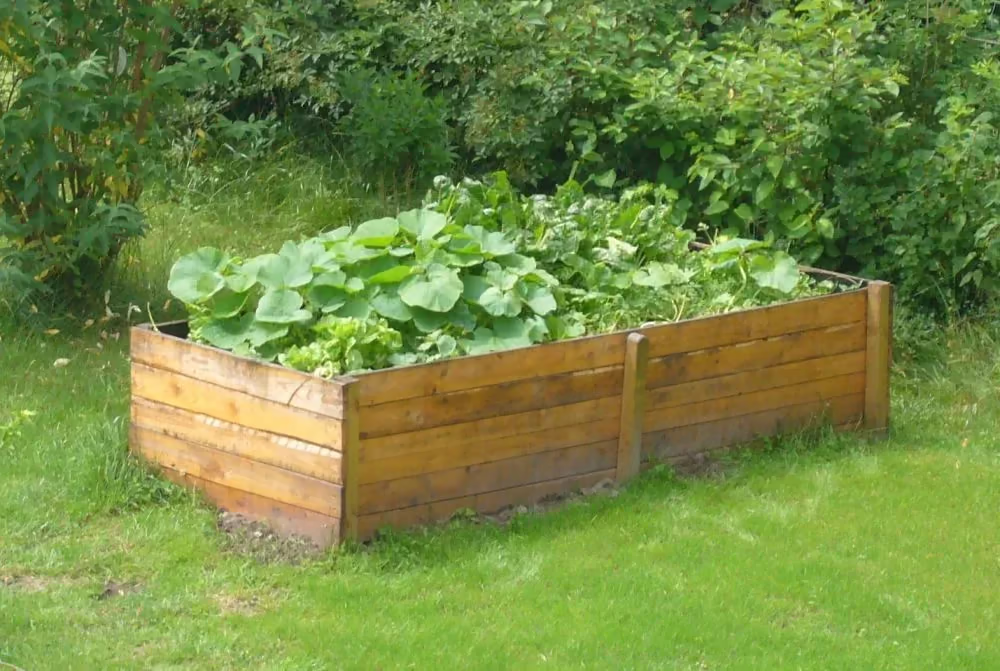
The most reliable structural solution: beds at least 30-40 cm high, the bottom lined with a heavy geotextile that isolates from the original soil (and stops deep roots going down into it). Fill with a loam / compost / vermiculite or perlite mix. Untreated wood for the sides (oak, chestnut, Douglas fir), definitely not CCA-treated wood. Over 100 € per 1 m² bed but durable for years.
- Step 5
Mulch permanently
Mulch limits contaminated-dust splash from the soil onto the leaves by rain or wind. It also avoids contact between low fruit (courgette, strawberry) and the soil. Straw, hay, RCW, dry clippings, dead leaves: all valid. Renew as soon as the layer drops below 5 cm.
- Step 6
Wash and prepare the vegetables correctly
For leaf vegetables eaten raw: soak for 5 minutes in water + 1 tablespoon of baking soda or vinegar per litre, then rinse. This removes the adhering dust. For root vegetables: scrub with a stiff brush under water, peel. The skin often concentrates more lead than the flesh.
- Step 7
Know when to give up
Some productions are to be avoided on heavily contaminated soil even with adaptations: lettuce and spinach on soil above 200 mg/kg of lead; any crop for children under 6 if lead is above 300 mg/kg; food intended for sale. Ornamental flowers, potted aromatics with imported soil, and fruit trees almost always remain possible.
Concrete examples
- A small 50 m² urban garden with 250 mg/kg Pb: 4 raised beds for leaf vegetables + tomatoes in the open ground + gentle annual liming + permanent mulch.
- A 500 m² industrial wasteland with 600 mg/kg Pb in spots: geotextile over 30 cm of clean fill, planting of fruit trees and vines (low accumulators).
- A family home with 80 mg/kg Pb (below the vigilance threshold): diversified cultivation kept up, careful washing, no particular works.
Common mistakes to avoid
- Acidifying the soil (the mistaken belief that it is 'more natural'): an acid pH worsens the bioavailability of metals.
- Composting plants from the contaminated soil: you recycle the pollution into the compost.
- Buying municipal compost without knowing its origin: some contain metallic traces linked to urban green waste.
- Burning boards of painted pallets or treated wood in the stove, then using the ash in the garden: this is how you contaminate a healthy plot yourself.
Tips & best practices
- Keep a 'clean' witness plot with imported soil for the sensitive crops (lettuces, strawberries, aromatic herbs).
- Have your vegetables analysed too (not just the soil) if the stakes are high: some laboratories offer it.
- Keep a journal of amendments and observations: pH, additions, rotations, it is the memory that makes efforts cumulative.
- More broadly, encourage permaculture practices (permanent cover, organic matter, biodiversity) that are themselves protective.
Frequently asked questions
- Can hyperaccumulator plants clean up my soil?
- Phytoremediation has been studied for 30 years (Thlaspi caerulescens for cadmium-zinc, Pteris vittata for arsenic, poplar and willow for various metals). Laboratory results are promising, but the time needed to significantly decontaminate a garden remains long (often several decades) and the effectiveness in an amateur garden is limited. To be seen as a complement to a strategy rather than a standalone solution.
- Can biochar help?
- Yes, moderately. Biochar (plant charcoal) holds back part of the metals, lead above all, then copper and cadmium, and working it in raises the soil pH, which holds metals more firmly on the soil particles (Rees, Simonnot and Morel, 2013, European Journal of Soil Science, INRA and Université de Lorraine). To be incorporated at a moderate rate. It is not decontamination, but a reduction of bioavailability.
- Can I trust municipal compost on urban soil?
- It varies. Waste-collection sites and green-waste collections in urban areas sometimes concentrate contaminated plants (roadsides, leaves with atmospheric dust). Ask the provider for an analysis sheet or favour home composting from controlled inputs.
- And the earthworms, are they affected?
- Worms accumulate metals but are relatively resistant to them. Their presence often indicates a living, functional soil, which is positive. The raptors and hedgehogs that eat them, however, can bioaccumulate in turn. That is one more reason to aim for low bioavailability through liming and organic matter.
Key takeaways
- Favour fruit over leaves and roots, the golden rule when in doubt.
- Neutral pH + abundant organic matter = a protective duo.
- Raised beds over geotextile: the surest option for sensitive crops.
- Always wash and peel roots, scrub leaves.
- For young children: a stricter precaution threshold.
Sources
- Rees, F., Simonnot, M.-O. & Morel, J.-L. (2013). Short-term effects of biochar on soil heavy metal mobility are controlled by intra-particle diffusion and soil pH increase. European Journal of Soil Science, 65(1), 149-161.
- Kabata-Pendias, A. (2011). Trace Elements in Soils and Plants (4e éd.). Boca Raton : CRC Press.
- Arrêté du 8 janvier 1998 fixant les prescriptions techniques applicables aux épandages de boues sur les sols agricoles, annexe I, tableau 2 (valeurs limites dans les sols)