In the pathway: Attracting pollinators, Organising a sustainable vegetable garden
Useful borders
The must-haves to plant along the edge of the vegetable garden.
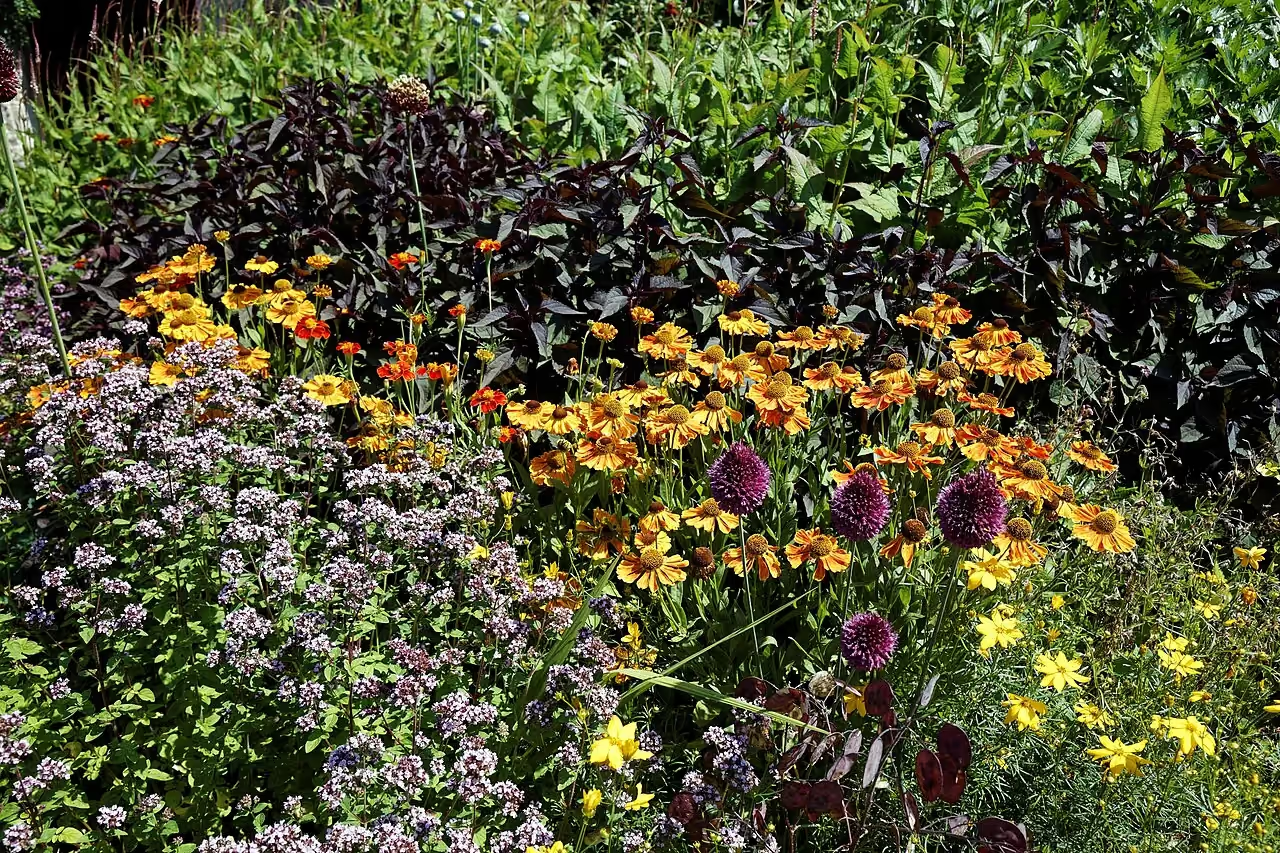
Introduction
Borders are edges: they often host a wide diversity of species, give beneficial insects a refuge and feed pollinators. A well-composed border multiplies the vegetable garden's resilience without taking away any of its useful area.
Background
In ecology, ecotones (transition zones between two habitats) mix the conditions of both; their effect on wildlife and plants varies with species (Ries et al., 2004). Vegetable-garden borders are our ecotones: they connect the wild and the cultivated, and continuously feed the useful insects.
Who this guide is for
Any vegetable garden, from the urban square to the family plot. Essential if you want to reduce treatments and encourage pollination.
Why it matters
Increases pollination and fruit set of neighbouring crops (a worldwide study of 41 crop systems, Garibaldi et al. 2013, Science, DOI 10.1126/science.1230200, showing the positive effect of wild pollinators). Feeds and shelters beneficials: on average, flower strips improve pest control in neighbouring plots (Albrecht et al., 2020). Breaks dry winds with low mini-hedges. Adds beauty and floral continuity.
What to understand before starting
Detailed steps
- Step 1
Mark out the border
Set aside a strip 30 to 80 cm wide around the vegetable garden, ideally on the sunny side.
- Step 2
Prepare the soil simply
Loosen with a broadfork, remove perennial roots (couch grass, bindweed). Do not enrich.
- Step 3
Sow the nectar-rich annuals
Borage, phacelia, pot marigold, dill, coriander. Sow in April–May, broadcast, and let them go to flower.
- Step 5
Keep a wild corner
Keep a square metre of nettles (cut back once a year): a refuge for many beneficials and butterfly caterpillars.
- Step 6
Stagger the flowering
Check that the border flowers from March (dandelion) to October (ivy, aster). Fill gaps as needed.
Concrete examples
Common mistakes to avoid
- Mowing the border systematically: you remove all the flowers.
- Enriching with compost: nectar-rich plants flop and flower less.
- Planting everything at once: concentrated flowering, then months of famine for the bees.
- Putting the comfrey right in the middle: very invasive, to be isolated.
Frequently asked questions
- Which border for damp clay soil?
- Comfrey, yarrow, hemp-agrimony, purple loosestrife, valerian.
Key takeaways
- A border = an edge, often rich in species.
- Continuous flowering from March to October.
- Poor soils, little upkeep, never mow entirely.
Sources
- Ries, L., Fletcher, R.J., Battin, J. & Sisk, T.D. (2004). Ecological responses to habitat edges: mechanisms, models, and variability explained. Annual Review of Ecology, Evolution, and Systematics, 35, 491-522.
- Garibaldi, L.A. et al. (2013). Wild pollinators enhance fruit set of crops regardless of honey bee abundance. Science, 339(6127), 1608-1611.
- Albrecht, M. et al. (2020). The effectiveness of flower strips and hedgerows on pest control, pollination services and crop yield: a quantitative synthesis. Ecology Letters, 23(10), 1488-1498.