Growing all year round under cover
Fleece, cold frame, tunnel or greenhouse: choosing your shelter, placing it, airing and watering it, to sow earlier, harvest later and pick leafy greens in the depths of winter.
Introduction
A transparent shelter lets the sun in, keeps its warmth and keeps out wind and showers alike. From a simple fleece laid over a bed to a glass greenhouse, it does not make summer in January: it brings spring forward, extends autumn and keeps, in the heart of winter, leaves to pick. This guide is about cold shelters, without heating, the kind a garden can run without spending energy.
Background
Shelters did not wait for plastic. Market gardeners settled at the gates of cities already grew on 'hotbeds', under cloches or frames, and so harvested melons as early as April (BnF). In permaculture, the shelter is an element of the garden to be placed like any other (see zones and sectors).
Who this guide is for
Gardeners who want to eat their own vegetables for more of the year, from a balcony with a cold frame to a large garden with a tunnel or a greenhouse.
Why it matters
Gaining weeks at both ends of the season; sheltering cold-sensitive summer crops (tomatoes, aubergines, sweet peppers, cucumbers) from the rain and cool nights; keeping something to pick when the garden outside is bare.
What to understand before starting
- A spot in sun all day long, including in winter, when shadows lengthen.
- Water close at hand, since showers no longer water what grows underneath.
- A few minutes almost every day to open up and close again depending on the weather.
- For a greenhouse taller than 1.80 m, a formality at the town hall (see the FAQ).
Detailed steps
- Step 1
1. Choose your shelter, from fleece to greenhouse
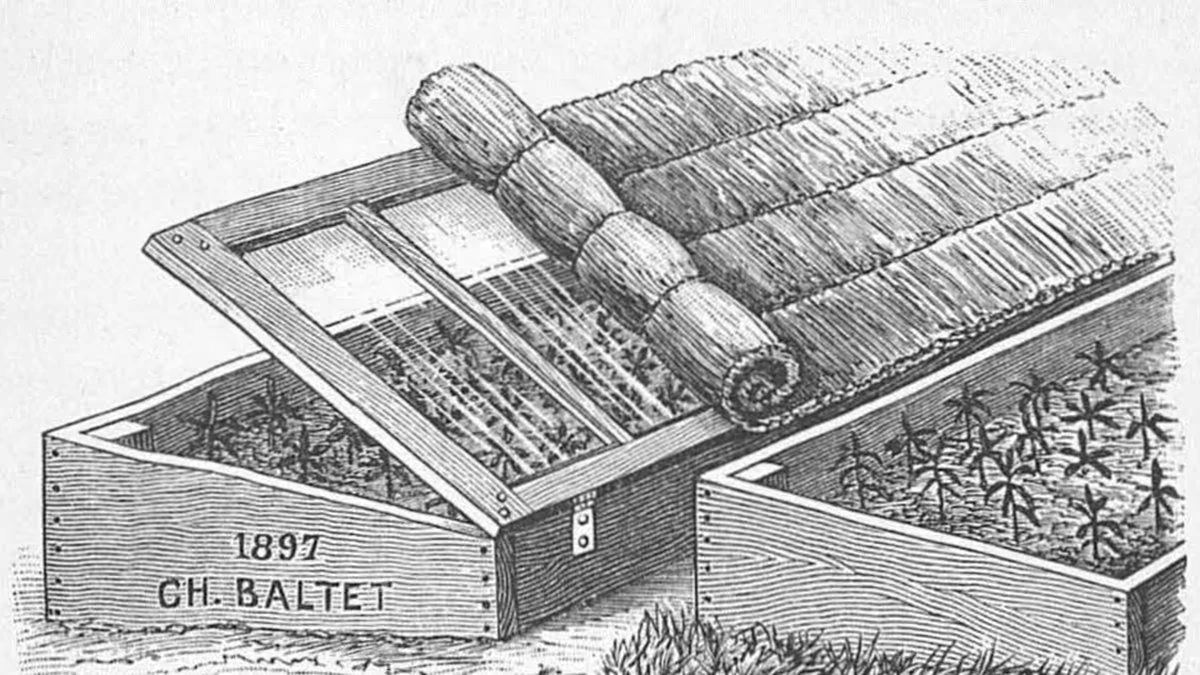
FLEECE goes over crops or over hoops: its heavier grades give about 2 °C of frost protection, the lightest (17 g/m²) protects less but lets through more light, and two layers do better than one (RHS). The COLD FRAME is a low box closed by a sloping glazed lid: young plants are hardened off in it in spring, and cold-sensitive crops get extra warmth from it in summer (RHS). The TUNNEL, a sheet stretched over hoops, is a very cost-effective way to shelter tomatoes and cucumbers in summer, but rarely economical to heat to keep it frost-free in winter (RHS). Finally the GREENHOUSE: glass lets through about 90 % of the light, does not degrade in sunlight and reflects back inside the heat radiated within the greenhouse; twin-wall polycarbonate lets through only about 83 %, but it is light, resists knocks and holds heat well (RHS).
- Step 2
2. Place it in the winter sun
Give the shelter sun all day long, and protect it from cold north and east winds, which keep temperatures low in spring and slow down seedlings (RHS). In winter, shadows lengthen: at midday, in the American Midwest, the shadow of a tree or a building already measures more than twice its height (Purdue University), and it grows longer still the further north you go; keep the shelter away from anything that could shade it. A greenhouse running east-west gains a little light in winter; running north-south, it suits summer crops such as tomatoes, lit from both sides (RHS). Built against a south-facing wall, it benefits from a wall that absorbs heat by day and gives it back at night (RHS). Finally, keep it close to the house and to a water point: a shelter you pass every day is a shelter well looked after (see permaculture zones).
- Step 3
3. Open, close, shade
Closed in the sun, a shelter heats up fast, even in winter. From spring to autumn, the greenhouse risks overheating: the RHS advises keeping it below 25 to 27 °C by opening the door and vents, and shading only as much as needed, with a net or a shading paint applied in spring to the outside of the glass, reduced from September and removed once ventilation alone is enough. Automatic wax vent openers help, with a delay, the time the wax takes to expand (RHS). In winter, open up on sunny mornings while avoiding blowing cold air straight onto the plants (high openings are better), and close again before the sun gets low or the clouds return, to keep the day's warmth (Purdue University).
- Step 4
4. Watering without rain
Nothing falls from the sky under cover: in season, check the watering every day, because irregular watering causes, for example, blossom-end rot in tomatoes (RHS). Water in the morning so that the foliage dries during the day; in autumn, overly frequent sprinkling feeds lettuce downy mildew (GRAB). Under a row of cloches or a low tunnel, a drip hose laid on the ground is useful in summer (RHS). And a tank collecting water from the roof keeps watering close at hand (see the guide Managing water in the garden).
- Step 5
5. The shelter's calendar
LATE WINTER: put cloches or a tunnel in place at least a week before sowing; the soil underneath can gain up to 10 °C, and direct sowings come up 10 to 14 days earlier (RHS). A cold greenhouse often stays too cool until April to germinate cold-sensitive seeds: start them off in the warm, indoors on a heated propagator, or on a hotbed (RHS). SUMMER: the greenhouse takes tomatoes, aubergines, sweet peppers, chillies and cucumbers (RHS). LATE SUMMER AND AUTUMN: sow what will spend the winter underneath, lamb's lettuce, rocket, mizuna and other young leaves for cutting, and plant out winter lettuces and spinach; chard, chicory and parsley, sown from early summer, carry their autumn harvest on into winter under cover (RHS; GRAB).
- Step 6
6. Warmth from below: the hotbed
Long before heating cables, seedlings were warmed from below. In a pit or a frame, under a cold frame lid, you spread 30 to 60 cm of fresh, strawy manure, horse manure for preference, then 15 to 30 cm of soil on top (New Mexico State University; Nebraska Extension). It is the decomposition that gives off heat: the manure must be fresh, not composted, and its warmth fades over the weeks, so you air the frame when it gets too hot (New Mexico State University) and renew the manure in spring and autumn (Nebraska Extension).
- Step 7
7. Getting through winter: light first
In the heart of winter, it is light that runs short, more than warmth. When the day lasts less than about ten hours, growth slows down sharply, even under a fairly warm shelter: the American winter-growing pioneer Eliot Coleman calls this low point the 'Persephone period' (Purdue University). The secret: plant early enough in autumn for the vegetables to be close to harvest size before that low point. The shelter then keeps them alive, like a larder, and you pick as you go; young leaves cut several times (rocket, spinach, kale) do keep growing, slowly, on sunny days, above about 4 °C (Purdue University). On frosty nights, a fleece laid over the crops under the shelter adds protection; take it off in the morning as soon as the air thaws, because left on all day it deprives the plants of about a third of their light (Purdue University). Finally, do not touch frozen leaves: left alone, they thaw and can be harvested undamaged, whereas handled, they get damaged (Purdue University).
- Step 8
8. Keeping the soil alive
Without rain, the salts brought by fertilisers, but also by compost and manure, are no longer washed out: they build up, sometimes to the point of forming a white crust on the surface, and plants struggle to draw water from the soil (Purdue University; Penn State). Choose a compost low in salts, avoid spreading manure directly on the soil of a tunnel or greenhouse (Purdue University), and only bring what the crops need: winter salads have few requirements, and excess is more common there than shortage (GRAB). The best remedy is to give the soil back to the rain: taking the cover off a tunnel for one winter washes out a good share of the salts (Purdue University; Penn State). Against soil diseases, change the vegetable family from one year to the next (see crop rotation); if they take hold anyway, the RHS advises renewing the soil of the beds every three to five years, or growing in large pots. Between two crops, a green manure covers the soil: leave three weeks between digging it in and the next planting (GRAB).
- Step 9
9. Heading off diseases and pests
Confined, humid air is a breeding ground for disease: under cover, the RHS names damping off, grey mould and powdery mildew, and on winter nights, when everything is shut, humidity stays very high around the plants for long periods (Purdue University). Air the shelter whenever the weather allows; in autumn, more ventilation at night slows growth a little but limits lettuce downy mildew and hardens the salads against frost; against that disease, GRAB relies above all on resistant varieties. Warm, dry air, for its part, makes red spider mite swarm: misting the foliage and wetting the paths in hot weather hold it back without being enough on their own, and the predatory mite Phytoseiulus persimilis is the most widely used biological control against it (RHS). Against whitefly, the tiny parasitoid Encarsia formosa is introduced before the infestation becomes heavy; yellow sticky traps mainly serve for monitoring, because they also catch beneficial insects (RHS). Before spring, clean up: debris, old canes and ties shelter the red spider mite females that overwinter (RHS). And let the pollinators in on mild days: in a closed greenhouse, tomatoes need help (see buzz pollination).
- Step 10
10. In a Mediterranean climate
The benchmarks in this guide come mostly from the RHS, in the United Kingdom, and from universities in the northern United States: they describe an oceanic or continental climate. In a Mediterranean climate, two things change. Winter there is brighter, because winter light also depends on latitude (Purdue University): the period of overly short days is briefer, and the GRAB in Avignon devotes a factsheet to lettuces, spinach, chard and lamb's lettuce grown under cover in autumn and winter. Summer, on the other hand, makes heat the main danger: in Provence, the GRAB advises whitening shelters, a first time in May and again in June, which lowers the temperature by about 5 °C, reduces the plants' water needs and limits sunscald on the fruit and blossom-end rot. A shelter left empty in high summer can also be used for solarisation: a clear film laid over well-watered soil, from mid-June to mid-July and for at least 45 days, reduces nematodes, most weeds and some soil fungi; in France it only works where June gets at least 250 hours of sunshine, and its heat does not sort: it also harms the useful organisms of the soil (GIS PIClég). Finally, on days of mistral wind, reduce the ventilation and do not open the doors wide, so as not to dry out the young plants (GRAB).
Concrete examples
- A tunnel planted in late summer with lettuces, spinach and lamb's lettuce, picked leaf by leaf until fine weather returns.
- A cold frame set in late winter over a bed of hot manure, to raise cold-sensitive seedlings without electricity.
- A greenhouse against the south wall of the house: tomatoes and sweet peppers in summer, winter salads afterwards.
Common mistakes to avoid
- Leaving the shelter shut on a fine morning and going out for the day: in the sun, the temperature inside climbs very fast and scorches the plants, even in spring.
- Watering in the evening and wetting the leaves in winter: the damp night opens the door to grey mould and lettuce downy mildew.
- Keeping the fleece on the crops from morning to evening: it keeps the air humid and holds back light that is already scarce.
- Sowing winter salads too late: short of light, they never reach harvest size.
- Putting tomatoes back in the same place year after year: soil diseases take hold.
- Loading the soil with manure or compost: with no rain to carry them away, salts build up.
Tips & best practices
- A maximum-minimum thermometer, in the shade and at plant height, tells you what the shelter goes through while you are away.
- Start small: a cold frame or a few hoops covered with fleece teach the gestures before investing in a greenhouse.
- On nights of hard frost, add a second fleece rather than leaving a thick one on all the time.
- Write down your sowing and harvest dates under cover: over the years, your calendar becomes more precise.
Frequently asked questions
- Do I need permission to put up a greenhouse?
- In France, a greenhouse or cold frame no more than 1.80 m high is exempt from any formality. Between 1.80 m and 4 m high, and up to 2,000 m² of floor area, a prior declaration at the town hall is required; beyond that, a building permit (Code de l'urbanisme, articles R421-1, R421-2 and R421-9). Near a historic monument, in a listed site or in a remarkable heritage site, the rules are stricter: ask at the town hall. Outside France, local rules apply.
- Can I harvest tomatoes in winter in a cold greenhouse?
- No. Without heating, a greenhouse in winter stays too cool and above all too dark for summer crops: it is then used for leafy greens and hardy roots, and the tomatoes come back in spring. Heating it is expensive, to the point that many gardeners try to limit the energy they spend on it, and even kept frost-free, at around 4 °C, it mainly allows more tender plants to be kept through the winter (RHS).
- Why have my salads stopped growing in December?
- Because the days are too short: shelter or not, growth slows to the point of seeming to stop. It picks up again at the end of winter, when the light returns (Purdue University). Until then, pick the leaves as you go, without waiting for them to get bigger.
Key takeaways
- A cold shelter does not create summer: it stretches the season, earlier in spring, later in autumn, and keeps fresh leaves all winter.
- The location matters as much as the shelter: winter light, no cold wind, the house close by.
- Air it every sunny day, even in January; water in the morning rather than the evening.
- In winter, light is in charge: plant early, then pick without waiting.
- Every so often, give the rain back to the soil, and do not grow the same family in the same place.
Sources
- RHS (Royal Horticultural Society) : « Greenhouses: choosing » (rhs.org.uk/garden-features/choosing-greenhouses)
- RHS : « Greenhouse: ventilation and shading » (rhs.org.uk/garden-features/ventilation-and-shading-greenhouses)
- RHS : « Vegetables: growing in your greenhouse » (rhs.org.uk/vegetables/growing-in-greenhouse)
- RHS : « Vegetables: growing for winter » (rhs.org.uk/vegetables/growing-for-winter)
- RHS : « Fleece and crop covers » (rhs.org.uk/prevention-protection/fleece-and-crop-covers)
- RHS : « Cloches: how to use them » (rhs.org.uk/prevention-protection/cloches)
- RHS : « Coldframes and mini-greenhouses » (rhs.org.uk/garden-features/coldframes-and-mini-greenhouses)
- RHS : « How to heat a greenhouse efficiently » (rhs.org.uk/advice/profile?pid=376)
- RHS : « Glasshouse red spider mite » (rhs.org.uk/biodiversity/glasshouse-red-spider-mite)
- RHS : « Glasshouse whitefly » (rhs.org.uk/biodiversity/glasshouse-whitefly)
- RHS : « Climbers and wall shrubs for sun » (rhs.org.uk/plants/types/climbers/for-sun)
- Maynard, E. T. & O'Donnell, M. (2019). Managing the Environment in High Tunnels for Cool Season Vegetable Production. Purdue Extension, HO-297-W.
- Guan, W. (2016). « Salt Accumulation for Vegetable Production in High Tunnels ». Vegetable Crops Hotline, Purdue University.
- Sánchez, E. « Dealing with High Soluble Salt Levels in High Tunnels ». Penn State Extension (mis à jour le 16 décembre 2025).
- Smith, C. (2008). Starting Plants Early Outdoors. New Mexico State University, Cooperative Extension Service, Guide H-220.
- Browning, S. (2022). « Pushing the Limits - Extend Your Growing Season with a Hotbed or Cold Frame ». Nebraska Extension in Lancaster County.
- GRAB : « Cultures d'automne sous abris : salade, épinard, blette, persil, mâche… », fiche technique, Réf Bio, septembre-octobre 2009 (grab.fr).
- Mazollier, C. (GRAB) (2020). « Dossier spécial : blanchiment des abris ». Réf Bio PACA maraîchage, mars-avril 2020 (grab.fr).
- GIS PIClég (avec le Ctifl) : « Fiche n°3, solarisation en culture maraîchère sous abri », série Protection contre les nématodes à galles.
- BnF : « Le maraîchage : une pratique aux portes des villes », bibliographie sélective, avril 2023.
- Code de l'urbanisme, articles R*421-1, R*421-2 (e) et R421-9 (g), versions en vigueur depuis le 16 novembre 2024 et le 19 février 2025 (Légifrance).